Best Fans for Hot Sleepers: Quiet Picks That Actually Cool (2026)
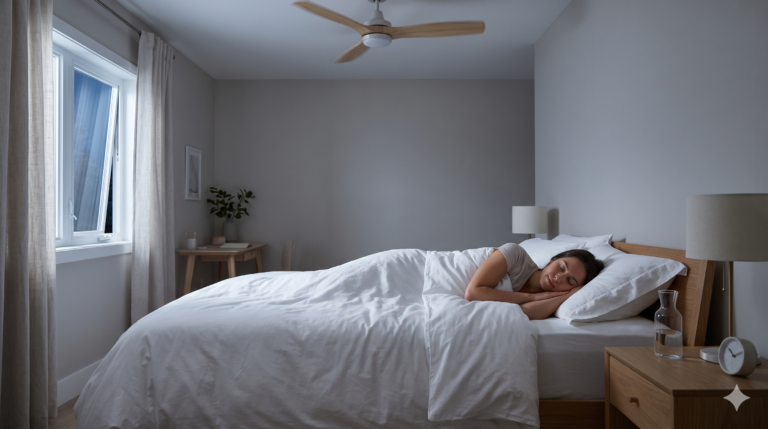
No sheet, topper, or pillow can do what a bedroom fan does: move air. Moving air accelerates sweat evaporation, drops perceived temperature by 4–6°F, and prevents the heat bubble that builds up around your body overnight.
The difference between the right fan and the wrong one is significant — especially for light sleepers. A fan that’s too loud, too directional, or too powerful creates a different kind of sleep disruption. The options below are specifically selected for bedroom use.
If you’re not sure whether airflow or bedding is your main heat problem, read our guide on why your bed gets so hot.
What to Look for in a Bedroom Fan
Noise level is the most important spec for hot sleepers. Look for fans rated below 30dB on their lowest setting — anything higher will be audible during light sleep. The gold standard is 20dB or below.
Oscillation matters for bedroom coverage. A fan that only blows in one direction creates a cold spot rather than circulating room air. Wide oscillation (90° or more) distributes airflow evenly across the bed.
Speed settings give you control. More settings = more precision. For sleep, you want the lowest effective setting — just enough airflow to prevent heat buildup without chilling the room.
Smart controls are worth paying for if you want to schedule cooling. Turning a fan on 30 minutes before bed, then reducing speed at midnight, is significantly more effective than running it at full speed all night.
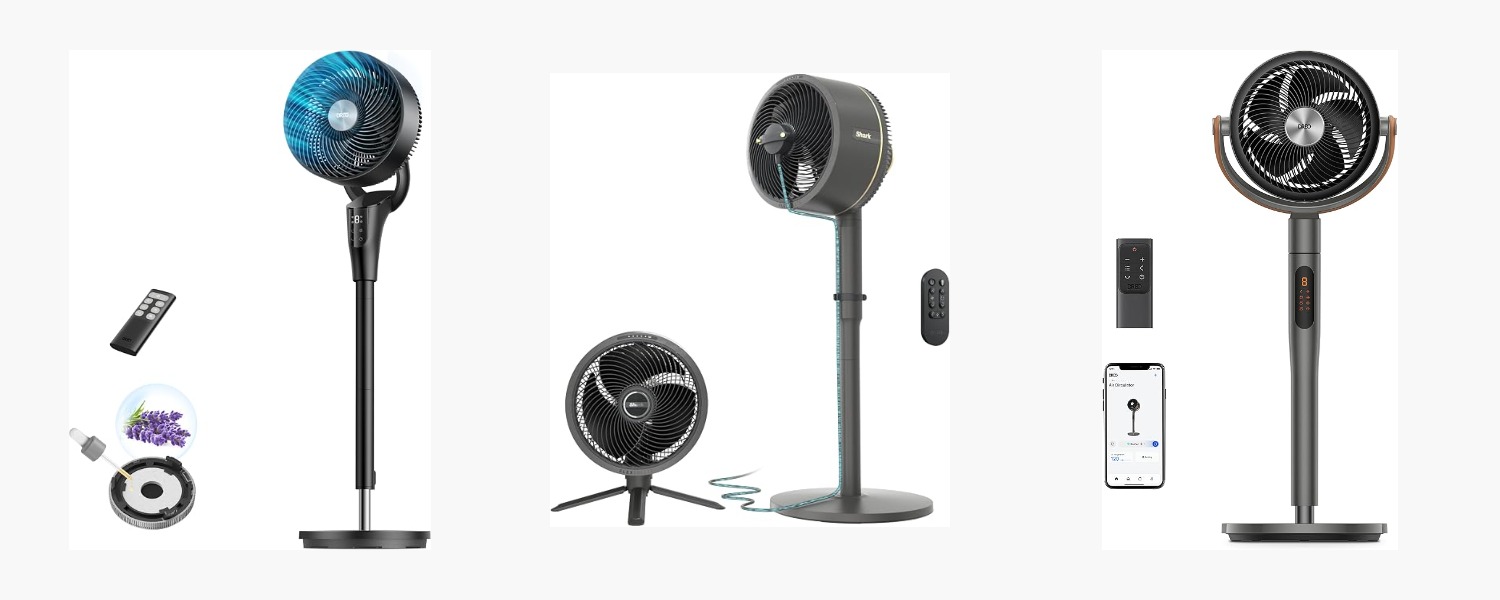
Remote control is worth having for bedroom use — adjusting fan speed from bed without getting up is a genuine benefit at 2AM. All three fans reviewed below include a physical remote in the box. The DREO Smart Pedestal also adds app and voice control via Alexa and Google Assistant for fully hands-free operation.
Tower Fan vs. Pedestal vs. Air Circulator vs. Bed Fan: Which Is Right for You?
Most hot sleepers default to a tower fan without thinking about whether it’s the right tool for their problem. Each type solves a different version of overheating.
| Type | Best For | Weakness | Noise |
|---|---|---|---|
| Tower Fan | Medium–large bedrooms, space-saving | Oscillation creates uneven coverage | 38–52dB |
| Pedestal Fan | Powerful directional airflow | Louder, oscillation disturbs light sleepers | 42–58dB |
| Air Circulator | Rooms that trap heat, no-draft preference | Less effective if room is already cool | 33–45dB |
| Bed Fan | Couples with mismatched temperatures | Doesn’t cool the room | 30–40dB |
| Ceiling Fan | Passive always-on room coverage | Requires installation, less precise control | Near-silent |
Rule of thumb: Room stays hot overnight → air circulator or tower fan. Body heat builds up under the covers → bed fan. You share a bed with a cold sleeper → bed fan or a tower fan aimed at your side only.
Best Fans for Hot Sleepers in 2026
Every fan below was selected based on verified customer reviews, noise performance, and suitability for bedroom use. None were sponsored or paid placements.

1. DREO Tower Fan 2026 Upgraded — Best Overall
⭐⭐⭐⭐⭐ 4.7 stars · 5,170 verified reviews
The DREO 2026 tower fan is the standout in this category — and the reason comes down to one number: 20dB. At that noise level on its lowest setting, it operates below the threshold most light sleepers can detect. You’ll feel the airflow before you hear it.
The 90° oscillation covers the full room rather than directing a focused stream at one spot. For couples where one person runs hot and one doesn’t, this matters — you get even circulation across the bed rather than one side freezing and the other not feeling anything.
The 8 speed settings are more useful than they sound. Most fans give you 3 options: low, medium, high — making it hard to find the exact right level for sleeping. The DREO’s 8 speeds let you dial in airflow precisely: strong enough to prevent heat buildup, quiet enough not to disrupt sleep. The 2026 model improved airflow efficiency and reduced motor noise compared to the previous version.
Price: $69.94
Rating: 4.7 stars · 5,170 reviews
Noise: 20dB (lowest setting)
Oscillation: 90°
Speeds: 8 settings
Why we recommend it: Selected based on 5,170 verified reviews at 4.7 stars, the lowest noise rating (20dB) of any fan in this category, and confirmed 2026 model improvements to airflow and motor noise. Not sponsored or paid for by the manufacturer.
Best for: Light sleepers, couples, bedrooms where noise is a concern

2. Shark FlexBreeze Fan — Most Versatile
⭐⭐⭐⭐ 4.4 stars · 1,116 verified reviews
The Shark FlexBreeze solves a problem no other fan on this list addresses: what happens when your bedroom fan needs to go somewhere else? It’s the only fan in this category that converts between a full-size tower fan and a portable handheld unit — detach the top section and you have a fan you can carry to the living room, take travelling, or use at your desk during the day.
For hot sleepers who struggle with heat throughout the day — not just at night — this eliminates the need to buy two separate fans. As a bedroom tower fan it performs well: quieter than average for its size, good oscillation coverage, and enough speed settings for sleep use. It won’t match the DREO’s 20dB rating, but for anyone who values flexibility over maximum quietness, the trade-off makes sense.
Price: $119.00
Rating: 4.4 stars · 1,116 reviews
Type: Tower / portable convertible
Why we recommend it: Selected based on 1,116 verified reviews and its unique convertible design — the only tower-to-handheld fan in this category. Its dual-use value makes it the best choice for hot sleepers who need cooling beyond the bedroom. Not sponsored or paid for by the manufacturer.
Best for: Hot sleepers who want one fan for the whole home, travel, flexible placement

3. DREO Smart Pedestal Fan WiFi — Best Smart Option
⭐⭐⭐⭐⭐ 4.7 stars · 3,761 verified reviews
The DREO Smart Pedestal Fan is the only fan on this list you can schedule — and for hot sleepers, scheduling is a meaningful upgrade over running a fan manually at a fixed speed all night.
Here’s why: your room temperature doesn’t stay constant. It’s warmest in the early evening, cools through midnight, and often drops significantly by 4–5am. Running a fan at the same speed all night means either too much airflow when it’s cool or not enough when it’s warm. With the DREO Smart, you set a schedule: high for the first 2 hours, medium through midnight, low by 3am. It adjusts without you touching anything.
WiFi integration works with Alexa and Google Assistant — no reaching for your phone at 2am. At $199.99 it’s the premium option, but for hot sleepers who’ve tried everything else and keep waking up at 3am, the scheduling capability addresses something no basic fan can.
Price: $199.99
Rating: 4.7 stars · 3,761 reviews
Connectivity: WiFi, Alexa, Google Assistant
Why we recommend it: Selected based on 3,761 verified reviews at 4.7 stars and its WiFi scheduling capability — the only fan in this category allowing automated sleep-cycle cooling without manual adjustment. Not sponsored or paid for by the manufacturer.
Best for: Smart home users, precision sleep scheduling, light sleepers who need hands-off control
Quick Comparison
| Fan | Best For | Noise | Remote | Price |
|---|---|---|---|---|
| DREO Tower Fan 2026 | Best overall — quietest powerful tower | 20dB (low) | Yes (Remote) | Check Price on Amazon → |
| Shark FlexBreeze | Most versatile — indoor/outdoor use | ~40–52dB | Yes (Remote) | Check Price on Amazon → |
| DREO Smart Pedestal WiFi | Best smart — app + scheduled cooling | ~40–50dB | Yes (Remote + App / WiFi) | Check Price on Amazon → |
How to Position a Fan for Sleep
Position matters as much as the fan itself. Pointing a fan directly at your face creates dryness and disrupts sleep. The most effective setup: place the fan at the foot of the bed aimed slightly upward, allowing air to circulate across the surface of the bed without blasting directly at your face.
For rooms with a ceiling fan, running it counter-clockwise in summer pushes air straight down, creating a wind-chill effect at bed level — combine with a tower fan on low for maximum circulation.
What to Pair With Your Fan
A fan handles airflow — the remaining heat sources are bedding and the mattress surface. Pair with cooling sheets that wick sweat before it builds up, a gel foam mattress topper that reduces heat from below, and a cooling pillow for head temperature control. See the full hot sleeper product guide for the complete system.
FAQ: Fans for Hot Sleepers
Do fans actually help hot sleepers?
Yes — significantly. Moving air accelerates sweat evaporation and drops perceived temperature by 4–6°F. A fan also prevents the heat bubble that naturally builds up around your body during sleep. Even on a cool night, stagnant air makes you sleep warmer than you need to.
What type of fan is best for sleeping?
Tower fans are the best choice for bedrooms. They oscillate widely, run quietly on lower settings, and take up minimal floor space. Avoid desk fans — they’re directional and typically noisier. Box fans move more air but at higher noise levels than most hot sleepers want overnight.
How loud is too loud for a bedroom fan?
Above 30dB becomes noticeable for most people during light sleep. The DREO 2026 tower fan runs at 20dB on low — below the threshold most light sleepers detect. If you’re a very light sleeper, prioritise noise rating above all other specs.
Should a fan blow on you while sleeping?
Not directly. Directing a fan at your face causes dryness and can disrupt breathing. Position the fan to circulate room air — at the foot of the bed aimed slightly upward, or across the room creating airflow that reaches you indirectly.
Is a fan enough or do I need AC?
A fan alone is sufficient if your room temperature stays below 75°F (24°C). Above that, a fan moves warm air without cooling it — you need AC or an evaporative cooler to actually reduce room temperature. Use the fan in combination with other cooling products for best results.
What decibel level is safe for sleeping with a fan?
Sleep researchers recommend keeping bedroom noise below 40dB for undisturbed sleep. Most bedroom fans on their lowest settings fall in the 32–45dB range — equivalent to a quiet library (30dB) to a quiet office (45dB). Light sleepers should look specifically for fans rated below 38dB on their lowest speed. All seven fans on this list fall within the sleep-safe range on their lower settings.
Ceiling fan vs. floor fan for sleeping hot — which is better?
Both work, but they solve slightly different problems. A ceiling fan running counterclockwise on medium speed drops perceived room temperature by 4–6°F passively and silently — it’s the best first-line option if you already have one installed. A floor fan gives directional control a ceiling fan can’t: you can aim it at your body, run it without bothering a partner, and adjust speed more precisely. Ideal setup: ceiling fan to lower ambient temperature, floor fan on low for direct airflow. If you’re choosing one and don’t have a ceiling fan already, a tower or air circulator is cheaper to deploy and gives more control.
Can a fan cause dry mouth or sinus dryness overnight?
Yes — direct airflow on your face accelerates moisture evaporation from your mouth, nose, and throat, especially if you’re a mouth breather. The fix is simple: don’t aim the fan at your face. Position it to blow across the room or angled at your torso and feet. An air circulator (like the Vornado) is a good alternative — it moves room air without a focused stream on your body. If dryness persists, running a small humidifier simultaneously offsets the moisture loss without reducing the cooling effect.
What’s the best fan setup for two people with different temperature preferences?
Two options work well: (1) a tower fan with narrow oscillation aimed at the hot sleeper’s side only — the cold sleeper stays out of the airflow path and adds a blanket if needed; (2) a dual-zone under-covers bed fan like a dual-zone bed fan, which gives each side of the bed independent control and doesn’t affect room temperature at all. For most couples, a well-positioned tower fan is the simpler and cheaper starting point.
Does fan white noise actually help you sleep?
Yes, for most people. Fan noise is a broadband low-frequency sound that masks environmental noise spikes — traffic, neighbors, a snoring partner — that would otherwise cause microarousals: brief partial wakings you don’t remember but that fragment your sleep quality. Research published in Sleep Medicine Reviews found that masking noise improves sleep onset time and reduces nighttime wakings. The cooling effect and the noise masking compound each other, making fans one of the few sleep products that solve two distinct problems simultaneously.
Which bedroom fans for hot sleepers come with a remote?
All three fans reviewed in this guide include a physical remote control in the box. The DREO Tower Fan 2026 and Shark FlexBreeze both ship with a dedicated IR remote for controlling speed, oscillation, and timer without leaving bed. The Shark FlexBreeze remote is especially useful — certain timer and breeze modes are only accessible via the remote. The DREO Smart Pedestal Fan WiFi goes further, adding WiFi connectivity for Alexa and Google Assistant voice control, making it the best option for fully hands-free bedroom operation.