
Best Bedroom Temperature for Sleep: What the Science Says
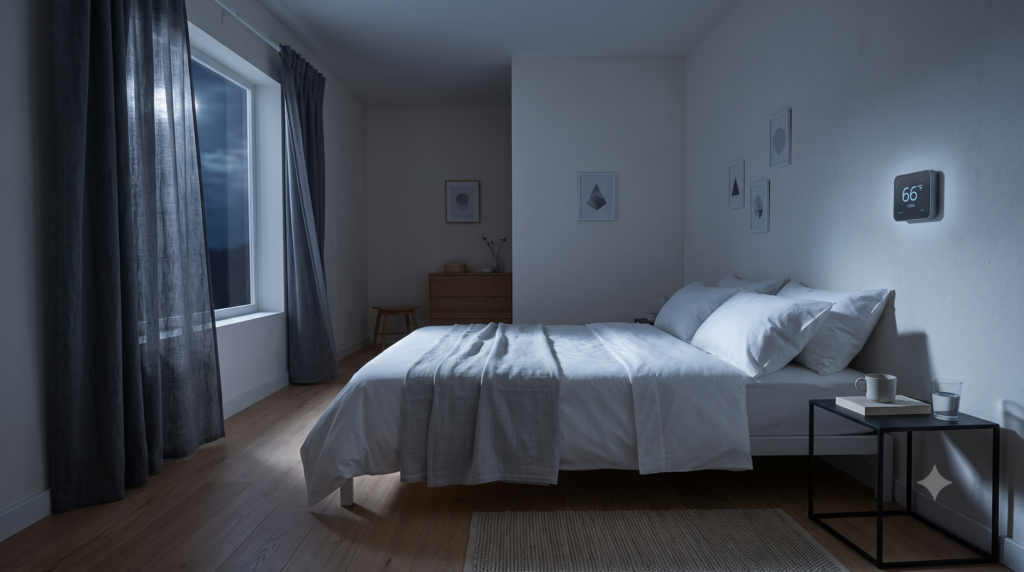
The optimal bedroom temperature for sleep is 65–68°F (18–20°C) for most adults. This isn’t a preference — it’s physiology. Your body has to lower its core temperature to fall asleep and stay in deep sleep. If your room is too warm, that process fights your environment all night.
The quick answer: The research-supported optimal sleep temperature is 65–68°F (18–20°C) for most adults. Above 70°F (21°C), sleep quality degrades — particularly deep sleep and REM. Below 60°F (15°C), most people have difficulty falling asleep without heavy bedding. If you consistently wake up sweaty, your room temperature is the first variable to check.
Why Temperature Is the Most Important Sleep Environment Factor
Of all the variables in your sleep environment — noise, light, humidity, mattress — core body temperature is the one your brain is most actively managing. Sleep onset is triggered in part by a drop in core body temperature. Your hypothalamus — the brain’s thermostat — orchestrates this drop as part of your circadian rhythm. When your room is too warm, the hypothalamus struggles to execute this cooling process efficiently, and sleep initiation is delayed or disrupted.
The relationship between temperature and sleep quality isn’t subtle. Research published in the journal Sleep Medicine Reviews found that thermal environment is “one of the most important physical factors affecting sleep.” Studies from the National Sleep Foundation consistently identify room temperature as a top complaint among poor sleepers — above noise and light.
What Happens to Your Body Temperature During Sleep
Your core body temperature follows a 24-hour circadian rhythm. It peaks in the late afternoon (around 4–6pm) and begins dropping in the early evening as melatonin production ramps up. By the time you fall asleep, your core temperature is already on its way down. It reaches its lowest point between 4–6am — roughly 1–2°F (0.5–1°C) lower than your daytime baseline.
This isn’t a passive process. Your body actively sheds heat to achieve this drop — primarily through vasodilation (widening blood vessels) in your hands and feet, which releases heat through the skin surface. This is why warm hands and feet are actually a reliable sign that sleep is imminent: your body is venting heat to cool your core.
If your room is too warm, two things happen. First, your body has difficulty achieving the necessary core temperature drop because the ambient environment keeps reheating it. Second, the vasodilation process that normally helps shed heat becomes less effective when the room temperature is close to your skin temperature. The result: delayed sleep onset, more frequent waking, and less time in deep, restorative sleep stages.
How Room Temperature Affects Each Sleep Stage
Not all sleep stages are equally affected by temperature. Understanding which ones suffer most helps explain why hot sleeping feels so damaging — it’s not just discomfort, it’s the quality of sleep stages that matter most for recovery.
Slow-Wave Sleep (Deep Sleep)
The most temperature-sensitive sleep stage. Slow-wave sleep (SWS) — also called deep sleep or N3 — is where physical restoration happens: tissue repair, immune function, growth hormone release. Core body temperature reaches its lowest point during SWS. A room that’s too warm compresses the time spent in this stage. Research from the University of South Australia found that even a modest increase in bedroom temperature (from 68°F to 75°F) significantly reduced SWS duration.
REM Sleep
During REM sleep, your brain becomes highly active and your body essentially loses the ability to regulate temperature through shivering or sweating — you become temporarily poikilothermic (temperature-dependent on environment). This makes REM particularly vulnerable to room temperature extremes. A room that’s too warm or too cold during the second half of the night (when REM periods are longest) disproportionately disrupts dreaming, emotional processing, and memory consolidation.
Light Sleep (N1 and N2)
Less sensitive to temperature than deep sleep or REM, but still affected. An uncomfortable room temperature tends to keep sleepers in lighter stages rather than progressing into deeper ones — resulting in more sleep cycles that feel shallow and unrefreshing even if total time in bed is adequate.
What Temperature Is Too Hot for Sleep?
Most sleep researchers identify 70°F (21°C) as the threshold above which sleep quality reliably degrades for most adults. Above this temperature, the research consistently shows:
- Increased sleep onset latency (taking longer to fall asleep)
- More frequent awakenings during the night
- Reduced time in slow-wave and REM sleep
- Increased reports of poor sleep quality — even when total sleep duration is unchanged
- Greater next-day fatigue and cognitive impairment compared to sleeping at 65–68°F
For hot sleepers specifically — people whose metabolism, hormones, or bedding cause them to generate or trap more heat than average — the effective threshold can be even lower. A room at 68°F (20°C) may still be too warm if the mattress is foam-based and trapping heat, or if the comforter is creating a microclimate several degrees above ambient. The room temperature and the sleep surface temperature are not the same thing.
See what chronic hot sleepers are actually doing about it: Hot Sleeper Solutions Reddit Recommends in 2026.
What Temperature Is Too Cold for Sleep?
Cold rooms are better tolerated than warm rooms for most people — the body can compensate for a cool environment more easily than a hot one. However, below approximately 60°F (15°C), sleep quality begins to suffer in the opposite direction:
- Increased shivering and muscle activation disrupts sleep continuity
- Increased cardiovascular stress from the body’s efforts to maintain core temperature
- More frequent awakening in the second half of the night when core temperature reaches its lowest natural point
- For older adults, who have reduced thermoregulatory efficiency, a cold room can be as disruptive as a warm one
The sweet spot for most adults — 65–68°F — splits the difference: cool enough that the body can easily shed heat to complete its circadian temperature drop, but not so cold that maintaining warmth requires physiological effort.
Optimal Sleep Temperature by Age Group
The 65–68°F recommendation applies to healthy adults. Other age groups have different thermoregulatory physiology and different optimal ranges.
Babies and Infants
Optimal range: 68–72°F (20–22°C). Infants cannot regulate body temperature efficiently — they can’t shiver to generate heat or sweat effectively to shed it. The American Academy of Pediatrics explicitly warns against infant overheating; the room should feel comfortable to a lightly dressed adult, not warm.
Children
Optimal range: 65–70°F (18–21°C). Children have more efficient thermoregulation than infants and can tolerate a slightly cooler room. Many children sleep hot due to high metabolic activity — a room at the cooler end of this range (65–67°F) is often better for active children.
Adults
Optimal range: 65–68°F (18–20°C). The most researched group. This range consistently produces the best outcomes for sleep onset, deep sleep duration, and next-day cognitive performance across multiple studies.
Older Adults (65+)
Optimal range: 68–70°F (20–21°C). Thermoregulatory efficiency declines with age — older adults lose heat more easily and have a narrower comfortable temperature range. A slightly warmer room (68–70°F rather than 65–68°F) is typically better tolerated. Cold rooms are disproportionately disruptive for older sleepers.
Pregnancy
Optimal range: 60–67°F (15–19°C). Basal metabolic rate increases significantly during pregnancy, raising core body temperature and making most pregnant people sleep substantially hotter than usual. A cooler room than average — combined with breathable bedding — is consistently reported as helpful.
How to Reach and Maintain the Optimal Sleep Temperature
Use a Fan
A bedroom fan doesn’t lower air temperature, but it drops perceived temperature by 4–6°F by accelerating sweat evaporation. On low settings, it also prevents the hot air your body generates from accumulating around you — maintaining the ambient temperature you set rather than letting a microclimate develop. For most hot sleepers, a fan running throughout the night makes more of a practical difference than air conditioning alone. See our best fans for hot sleepers guide for quiet bedroom-specific picks.
Start Cooling the Room Before Bedtime
A room cooled 30–60 minutes before bedtime reaches the target temperature more reliably than one cooled only at lights-out. Thermal mass — walls, floors, furniture — absorbs heat during the day and releases it slowly. Giving the room time to shed that stored heat before you get in bed produces consistently cooler sleeping conditions than cooling on-demand.
Address Your Bedding
Room temperature and sleep surface temperature are different. A room at 67°F with a foam mattress and synthetic comforter can produce a sleep surface 10–12°F warmer.
Room at 68°F but still sweating?
Your mattress may be acting like a thermal oven — absorbing body heat and radiating it back at you all night. The room temperature is fine. The sleep surface isn’t. Read our guide: How to fix a bed that sleeps too hot →
Cooling sheets, a quality mattress topper, and a breathable comforter close this gap. See our best bedding for hot sleepers guide for the material breakdown and product picks.
Reduce Heat Sources in the Room
Electronics generate continuous heat. A gaming console, large TV, and several phone chargers can raise room temperature measurably over several hours in a sealed bedroom. Power off (not standby) any devices you don’t need running. On the window side: close blackout curtains on west-facing windows from early afternoon to prevent solar heat gain from accumulating in the room. See our room too hot guide for the full list of causes and fixes.
Use Humidity as a Lever
High humidity doesn’t raise temperature — it makes the same temperature feel significantly hotter by slowing sweat evaporation. A room at 70°F with 80% humidity feels worse than 72°F at 40% humidity. Target 40–50% relative humidity for sleep. A dehumidifier or air conditioner (which dehumidifies as it cools) achieves this. Hygrometers — inexpensive bedside devices that display both temperature and humidity — are worth having if you’re troubleshooting a hot sleep environment.
Frequently Asked Questions
What is the ideal bedroom temperature for sleep?
65–68°F (18–20°C) for most adults. This range is supported by sleep research as the optimal thermal environment for sleep onset, deep sleep duration, and next-day cognitive performance. Infants need slightly warmer (68–72°F). Older adults typically sleep better toward the warmer end of the adult range (68–70°F).
Is it better to sleep in a cold room or a warm room?
Cold room. Your body needs to lower its core temperature to enter and sustain deep sleep — a cool room assists that process while a warm room works against it. A room that’s too cold (below 60°F) is easier to compensate for with extra bedding than a room that’s too warm. For most people, the ideal is cool-but-comfortable, not cold.
Why do I sleep better when it’s cold outside?
Because the room is closer to the optimal sleep temperature without any intervention. In summer, your room accumulates heat during the day and often stays above 70°F at night — disrupting deep sleep and REM. In winter, rooms naturally sit closer to 65–68°F. The sleep quality difference you notice isn’t psychological — it’s your deep sleep and REM stages actually completing more fully.
Does room temperature affect how long it takes to fall asleep?
Yes, significantly. Sleep onset requires a drop in core body temperature. In a warm room (above 70°F), this drop is delayed — the ambient heat keeps reheating your skin surface faster than your body can shed heat. Studies have found that a warm sleep environment can increase sleep onset latency by 15–30 minutes compared to an optimal-temperature environment.
Why does my room feel hotter at night than during the day?
Thermal mass. Your walls, ceiling, floor, and furniture absorb heat from sunlight and ambient air during the day and release it slowly at night — often hours after outdoor temperatures have dropped. Top-floor rooms and west-facing rooms are most affected. A fan accelerates heat removal; closing blackout curtains before afternoon sun hits the windows prevents heat absorption in the first place.
Should I sleep with the window open or the AC on?
Open window if outdoor temperature is below your indoor temperature and outdoor humidity is low. AC if outdoor temperature or humidity is high — humid outside air entering a room can make the effective temperature feel warmer even if the thermometer reading is lower. The goal is 65–68°F at 40–50% relative humidity. Use whichever method gets you there.
My room temperature is fine but I still sleep hot — why?
Room temperature and sleep surface temperature are not the same. A foam mattress at 67°F can create a sleep surface 10–12°F warmer due to heat absorption. Synthetic bedding amplifies this further. If your room is within the optimal range but you still overheat, the problem is your mattress, sheets, pillow, or comforter — not the room. See our full guide on why your bed is too hot for the diagnostic breakdown.
How does humidity affect sleep temperature?
High humidity makes the same temperature feel significantly hotter by slowing sweat evaporation — your body’s primary cooling mechanism. At 80% humidity, a 70°F room can feel as uncomfortable as a 76–78°F room at 40% humidity. If your bedroom feels sticky or oppressive rather than just warm, humidity is likely amplifying the problem. Target 40–50% relative humidity using a dehumidifier or air conditioner.