Why Is Your Bed Still Hot When the AC Is On? (5 Real Causes)
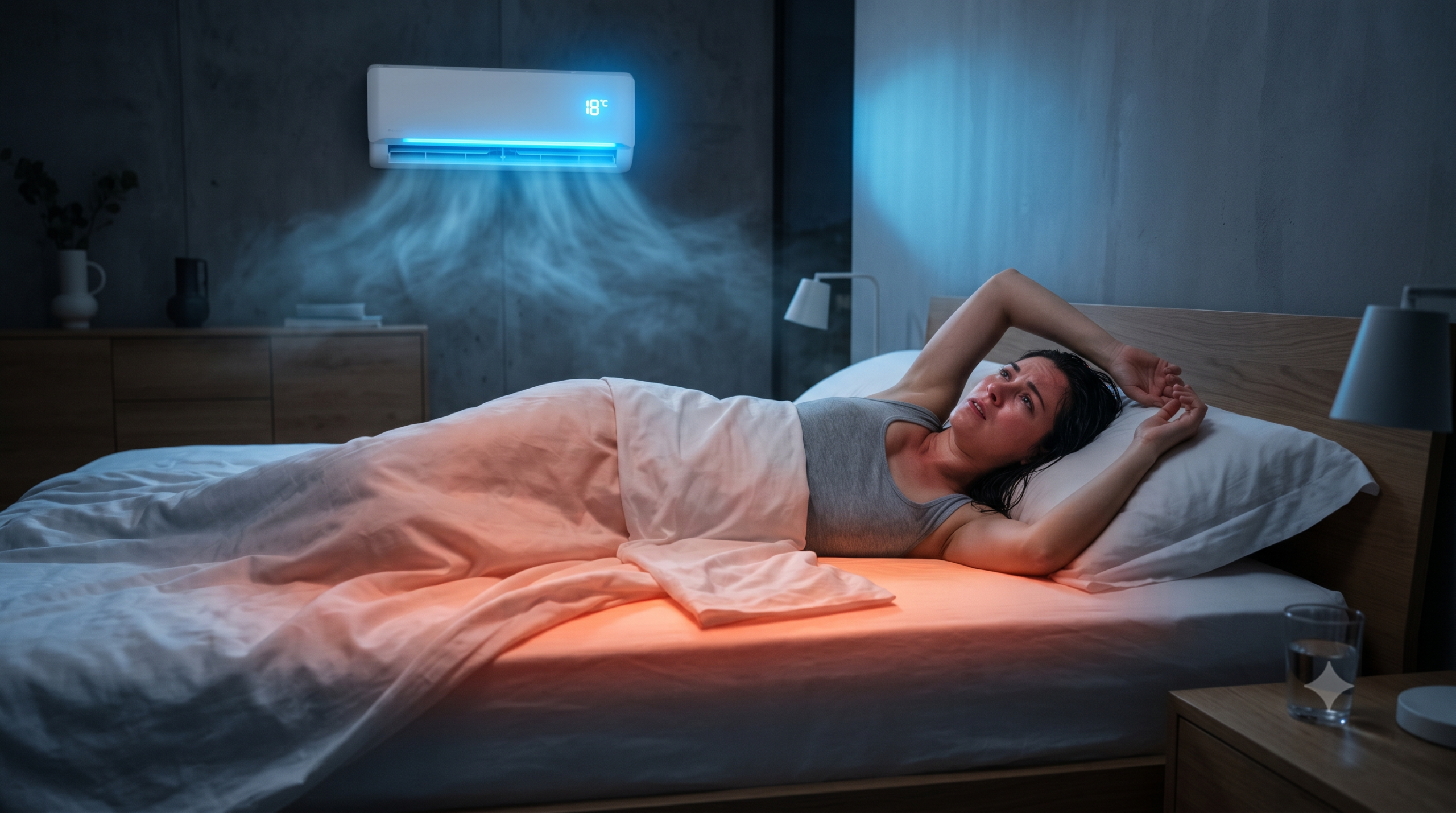
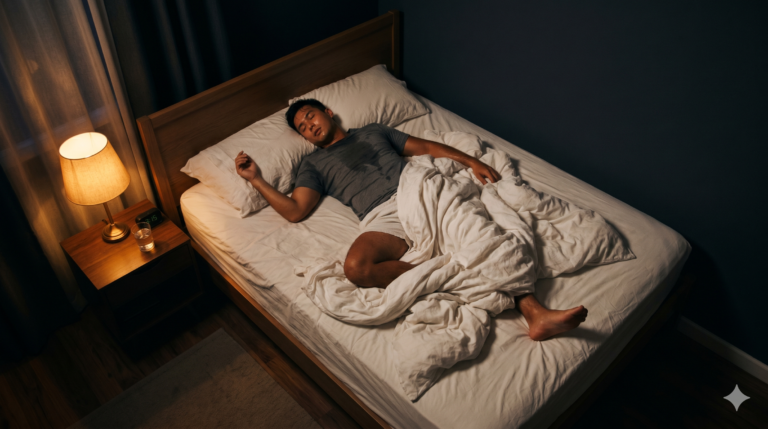
You’re sleeping in a 68°F room with the fan running. Thermostat cranked down. Maybe sleeping naked. Still waking up soaked.
The problem isn’t your thermostat. You’re cooling the wrong thing. Here are the five actual reasons your bed stays hot — and what fixes each one.
The 5 causes at a glance:
- You’re cooling the room — not the bed (AC can’t reach your contact surface)
- Memory foam is absorbing and storing your body heat all night
- Your “cooling” gel layer burned out after the first hour
- High thread count sheets have almost no airflow (the tarp effect)
- Your body is sealed in a closed thermal system no fan can reach
Cause 1: You’re Cooling the Room — Not the Bed
This is the root misunderstanding behind every other problem on this list.
The fastest fix for a hot bed is moving air — the right fan for hot sleepers drops perceived temperature 4–6°F by accelerating sweat evaporation directly at the skin.
When you turn on the AC, it cools the ambient air in the room. But your body isn’t in contact with the air — it’s in contact with the top four to six inches of your mattress. Those are two completely different thermal systems.
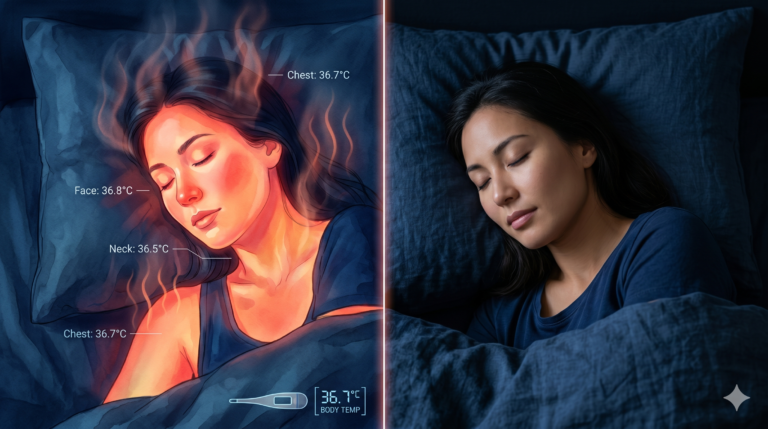
Your sheets, comforter, and mattress surface create a sealed microclimate around your body. That zone doesn’t exchange freely with the rest of the room. The air near the ceiling can read 68°F while the surface your skin is pressing against runs significantly warmer — and the AC has no way inside.
“Humidity was the missing piece for me. Kept lowering the thermostat and swapping bedding for months, but my room was basically a cave with no airflow. Once I started tracking humidity, the pattern was obvious: sweaty nights lined up with the muggy ones.”
— loll-2862, r/BedroomBuild
Humidity makes this dramatically worse. At 70% room humidity, sweat has nowhere to evaporate — and evaporation is what actually cools you. A 70°F room at 70% humidity can feel hotter than a 65°F room at 50%. A cheap hygrometer tells you your number instantly.
Cause 2: Memory Foam Acts Like a Thermal Battery
Memory foam is a closed-cell material. It softens in response to body heat — that’s the contouring sensation people pay for. The same property that makes it feel luxurious is what traps heat.
When you lie down, your body heat warms the foam directly beneath you. By midnight you’re not lying on a neutral surface — you’re lying on material that has been absorbing your body heat for hours, getting progressively warmer as the night goes on.
“I can’t use memory foam mattress or pillow. It just gets too hot.”
— anvilfoot, r/BedroomBuild (switched to a latex mattress)
This surprises people who buy a foam topper expecting cooling relief. A foam topper adds another layer of closed-cell material — more heat absorption, not less. If your mattress sleeps hot, a memory foam topper is the wrong direction.
Cause 3: The Cooling Gel Layer Only Works for About an Hour
Most premium memory foam mattresses include a “cooling gel” infusion or comfort layer. It feels genuinely cool when you first lie down. The problem: that absorption has a limit.
“After about an hour or two of lying in the exact same spot, that gel reaches its maximum capacity for heat absorption. At that point, it stops being a cooling layer and simply becomes a hot pad radiating your own body heat back at you for the rest of the night.”
— BedGuide (sleep and mattress industry professional), r/BedroomBuild
The gel layer delays the heat problem by 45–60 minutes. It is not a solution. This is why people who spent $3,000 on a “cooling mattress” still wake up hot at 1am.
Cause 4: High Thread Count Sheets Are Making It Worse
Most people assume premium, high-thread-count sheets are the right upgrade for hot sleepers. This is backwards.
Thread count measures how tightly the fabric is woven. A 1,200-thread-count Egyptian cotton sheet is woven so densely that almost no air can pass through it.
“A thread count that high means the fabric is woven so incredibly tight that no air can pass through it. It’s like sleeping under a finely woven luxury tarp.”
— BedGuide, r/BedroomBuild
For hot sleepers, lower thread count is better. A 250-count cotton percale has an open weave that breathes. Bamboo and Tencel wick moisture. Linen has the highest airflow of any bedding material — it feels rough at first but hot sleepers consistently rate it the most comfortable in warm conditions.
The rule: the more you spend on thread count, the worse your sheets often are for sleeping hot.
Cause 5: Your Body Is Sealed Inside a Closed System
Body position amplifies everything above. When you lie down, the parts pressing into the mattress — hip, shoulder, lower back — compress the foam and create a near-seal between skin and surface. Heat collects and has nowhere to go.
Add a comforter above and the effect multiplies: heat source (your body), surrounded by insulation on both sides, no meaningful airflow reaching the actual contact surfaces.
“I can’t sleep without a blanket on. It freaks me out for some weird reason. I have been like that since I was a kid.”
— oop-eep869, r/AskReddit
Many hot sleepers can’t simply “stop using covers” because the weight or security of a blanket is a genuine comfort need. If that’s you, the fix isn’t removing the blanket — it’s changing what’s underneath it.
What Doesn’t Work — and Why
Before you spend more money on the wrong fix:
Running the fan — Improves room airflow. Doesn’t reach the sealed microclimate inside your bedding. Marginal help, not a fix.
Lowering the thermostat — Cools the room air. Doesn’t change the thermal properties of what you’re lying on. One person in the r/AskReddit thread kept their thermostat at 68°F, ran a fan, slept in nothing but a sheet — still woke up soaked. Cold room, hot bed.
Sleeping naked — Reduces some insulation. Doesn’t change the mattress surface. Minimal improvement.
Upgrading to denser memory foam — Denser foam releases heat more slowly. A more expensive foam mattress can make the heat problem worse, not better.
Standard mattress protectors — Most are polyester with a waterproof layer. They seal your mattress in plastic wrap, cancelling any breathability your mattress has. Switch to an all-cotton mattress pad if you need protection.
“It provides a waterproof layer, but it’s sealing that expensive mattress in a plastic bag and nullifies the airflow.”
— catch22nick, r/BedroomBuild
What Actually Works
The core problem is the contact surface — the material your body presses against for seven to eight hours. Two approaches actually change that directly:
Option 1: Replace the Contact Material (~$80–$200)
A natural latex or PCM (phase-change material) topper placed on top of your existing mattress replaces closed-cell foam with open-cell material that doesn’t trap heat the same way. No setup, no noise, no electricity required.
“Ended up getting a latex slab mattress. Lovely when it’s hot.”
— anvilfoot, r/BedroomBuild
See our full guide: Best Cooling Mattress Toppers for Hot Sleepers →
Option 2: Add Active Cooling to the Bed (~$400–$700+)
Air-based and water-based active cooling systems pump conditioned air or chilled water directly through your bedding — targeting the microclimate inside your bed that your AC cannot reach.
For most people: start with the topper. It solves 80% of the problem at 20% of the cost. If you need dual-zone temperature control for a couple, active systems are worth the investment.
⚠️ What to Know Before You Buy — Cooling Mattress Toppers
Latex toppers (recommended for most hot sleepers):
- Heavier than foam — rotating the mattress solo is awkward.
- On mattresses over 14″ thick, standard fitted sheets may not stay put. Fix: mattress topper clips (~$7 on Amazon).
- Off-gassing on first unboxing — air out for 24–48 hours before sleeping on it.
- If your mattress is already soft, start with 2 inches, not 3.
Gel memory foam toppers — avoid if you sleep hot:
- Same closed-cell structure as your mattress. Saturates in under an hour.
- Designed for pressure relief, not sustained cooling. Wrong product for this problem.
Not sure which cause is yours?
Take the free Hot Sleeper Diagnostic — figure out which of these 5 causes is your specific problem and the cheapest fix for your situation.
Sources
Thread 1: r/BedroomBuild — “If you’re a hot sleeper waking up drenched in sweat, here is why your setup is failing you” — u/BedGuide, 992 upvotes. Comments cited: u/loll-2862, u/anvilfoot, u/catch22nick, u/BeneficialWheel4696, u/kaorte.
Thread 2: r/AskReddit — “Hey Reddit, why do I get so hot while I am sleeping?” — u/oop-eep869, archived. Comments cited: u/grigri, u/VisualSourceSafe, u/RedErin, u/mrregan.
Note: The r/BedroomBuild post by u/BedGuide is authored by a sleep and mattress industry professional. Technical information from this source is treated as industry knowledge, not personal anecdote.