
Why Do Women Sleep Hotter Than Men? The Biology Explained

You go to bed at the same time, in the same room, under the same duvet. He falls asleep immediately and stays there. You spend the night kicking off covers, pulling them back, waking at 3am drenched, staring at the ceiling while he sleeps peacefully beside you.
This is not in your head. Women genuinely run hotter at night than men — and the reasons are biological, not personal. Understanding why is the first step to actually fixing it.
The Biology: Why Women Run Hotter at Night
Hormones Control Your Internal Thermostat
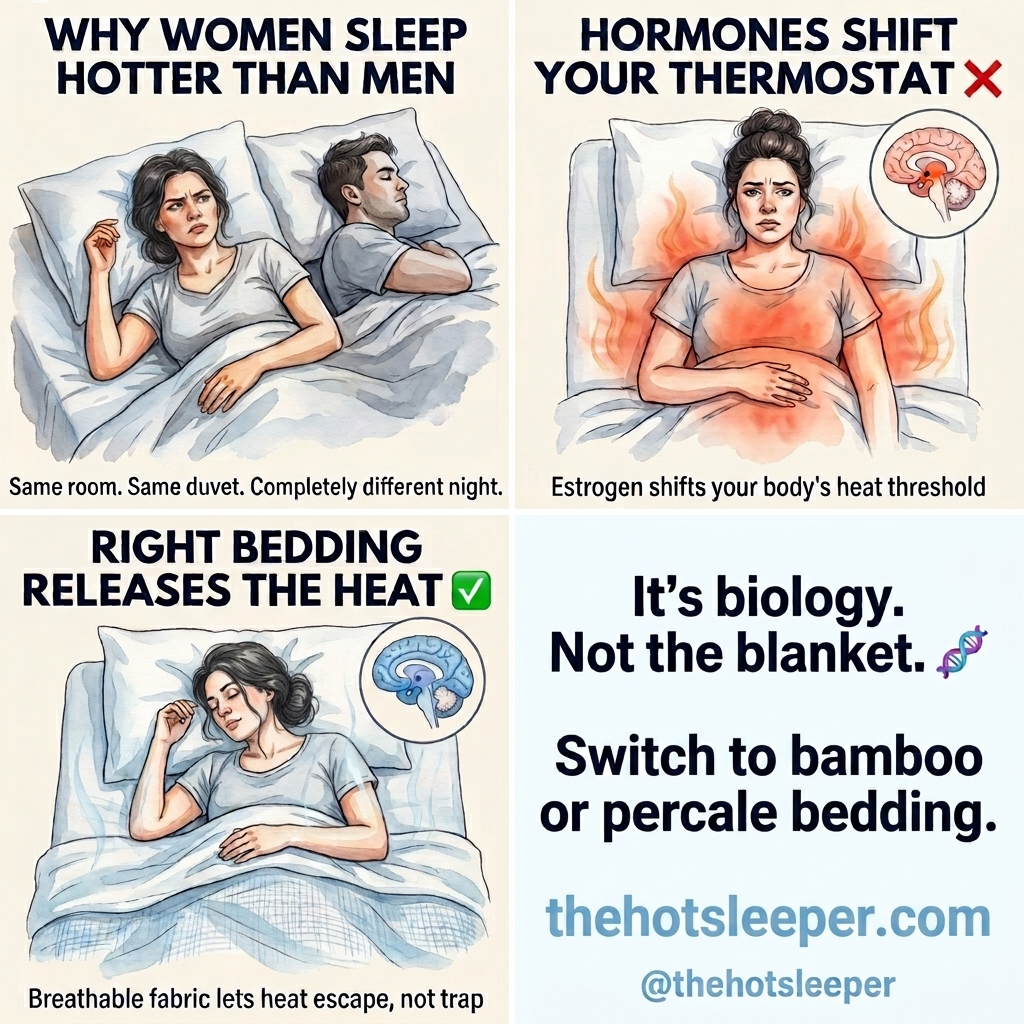
The hypothalamus is your body’s temperature regulator. It decides when to dilate blood vessels, trigger sweating, or generate heat. Estrogen directly modulates how sensitive this thermostat is — and women’s estrogen levels shift dramatically across the monthly cycle, across decades, and across life stages in ways men’s testosterone simply does not.
During the luteal phase (roughly days 15–28 of your cycle), progesterone rises and raises your basal body temperature by 0.3–0.5°F. That might sound small. At 3am, during your longest REM cycle — when your body has temporarily stopped regulating temperature — it is enough to push you over the edge.
Perimenopause and Menopause: When the Thermostat Breaks
For women in their late 30s through their 50s, falling estrogen levels narrow the hypothalamus’s thermoneutral zone — the temperature range in which it stays calm. In younger women, the body tolerates a 2°F swing without reacting. In perimenopause, that window can narrow to less than 0.4°F. Anything outside it triggers an emergency heat-dump response: rapid vasodilation, sweating, the sensation of being lit on fire from the inside.
This is a hot flash. It affects up to 80% of women during perimenopause, frequently striking between 2am and 4am — when REM sleep peaks and thermoregulation is most vulnerable.
One woman in r/Menopause described tracking hers for months: “They hit almost exactly three hours after I fall asleep. Even weirder — they’re way worse if I eat sugar before bed.” Another: “It’s not just a flash. It’s feeling like my body is about to burst into flames for a few hours.”
The Luteal Phase Even Before Perimenopause
You do not have to be approaching menopause to feel this. Women in their 20s and 30s regularly report waking hot in the second half of their cycle — the week before their period, when progesterone is highest. This is physiologically normal. It is also completely overlooked by most sleep advice, which treats sleep temperature as a fixed preference rather than a moving biological target.
Thyroid, PCOS, and Other Amplifiers
Women are five to eight times more likely than men to develop thyroid disorders. An overactive thyroid raises metabolic rate, which generates excess heat — including at night. PCOS involves hormonal dysregulation that can also disrupt thermoregulation. These conditions amplify an already difficult sleep environment.
Body Composition and Heat Distribution
Women carry more subcutaneous fat (directly under the skin) and less visceral fat than men. This layer acts as insulation — useful in cold climates, counterproductive in a warm bed. Women also have a smaller body surface area relative to volume, meaning heat has fewer routes out. The result: heat that builds up overnight has nowhere to go, especially if bedding is blocking airflow.
The 3am Connection
If you consistently wake between 2am and 4am feeling overheated, the timing is not random. Your longest REM cycle peaks around 3am — and REM is the stage when your body temporarily suspends active thermoregulation. Whatever heat has been building up in your bedding and mattress hits you all at once, with no biological buffer to absorb it.
Add the cortisol rise that begins around 3am (your body preparing for the day), and for women in the luteal phase or perimenopause, you have three systems colliding simultaneously. For the full biology of why 3am specifically, see our deep-dive on waking up hot at 3am.
The Cooling Products That Actually Work
The environment you sleep in is the only variable you can fix tonight. Hormones require medical support. Your bedding requires the right materials. These are not the same product category — most cooling products marketed to women are not actually designed around thermoregulation science. Here is what the research and real-world testing shows works.
-
Cooling Sheets — Your Highest-Impact Change
Standard polyester or microfiber sheets trap heat against the skin. During the night, they function like a sleeping bag liner — keeping your body heat in rather than letting it escape. For women who sleep hot, this is the single most impactful product change.
The two materials that actually perform are bamboo viscose (moisture-wicking, breathable, soft against sensitive skin) and percale cotton (crisp, open-weave construction that allows airflow). Both outperform microfiber at every temperature. Thread count above 400 in any material adds density and heat retention — go lower, not higher.
See our full guide: Best Cooling Sheets for Hot Sleepers — Researched and Ranked.
-
Cooling Mattress Topper — Fix the Surface You’re Sleeping On
Traditional memory foam absorbs and holds body heat. By 3am, an older foam mattress is radiating warmth back at you — exactly when thermoregulation is most impaired. A gel-infused or copper-infused foam topper creates a significantly cooler sleep surface without requiring a new mattress.
For women with severe night sweats, an active cooling pad (ChiliPad, BedJet, or 8Sleep Pod) circulates temperature-controlled water or air through the mattress surface. Multiple r/Menopause members cited this as the only product that made a measurable difference: “I cannot sleep without my ChiliPad. It is like sleeping on air conditioning.” These are expensive — but so is years of broken sleep.
See our full guide: Best Cooling Mattress Toppers — What Actually Works.
-
Cooling Pillow — Your Head and Neck Are Major Heat Zones
Your head and neck radiate a disproportionate amount of body heat — which is why a cool pillow provides immediate, noticeable relief. A solid foam pillow absorbs and holds this heat, turning a natural heat-release point into a heat source. Shredded memory foam with gel inserts, latex, or buckwheat hulls all allow significantly more airflow than solid foam.
See our full guide: Best Cooling Pillows for Hot Sleepers.
-
Cooling Comforter — Replace the Heat Trap
A down-alternative or synthetic comforter that feels fine in winter becomes a problem in spring and summer, or year-round if you run hot. Cooling comforters use phase-change materials (PCM) or arc-chill fabrics that actively absorb heat rather than reflect it back. If you have been waking up and throwing your duvet off, it is likely contributing to the problem.
See our full guide: Best Cooling Comforters for Hot Sleepers.
-
Room Temperature — The Non-Negotiable Foundation
No product compensates for a room above 70°F. The optimal sleep temperature is 65–68°F (18–20°C). For women in perimenopause, erring toward the cooler end — 65°F — gives the thermostat more margin before a hot flash triggers. If you do not have air conditioning, a fan exhausting warm air out through a window is more effective than one blowing air at you.
-
What Makes It Worse — Cut These First
Alcohol within three hours of sleep causes vasodilation, disrupts REM architecture, and suppresses the liver’s overnight processing — all of which increase night heat. As one r/Menopause member tracked precisely: “Absolutely tied to sugar and alcohol. Four cookies or a slice of cake and the Wave of Sweats will arrive.”
A large meal within two hours of bed keeps your liver metabolically active through your peak-REM window. Magnesium glycinate — mentioned repeatedly in the research as reducing night sweats — is worth discussing with your doctor.
When to See a Doctor
If your sleep is being destroyed nightly, do not troubleshoot your bedding alone. A doctor familiar with hormonal health can evaluate whether HRT, progesterone support, or thyroid assessment is appropriate for your situation. Night sweats soaking through sheets consistently, or hot flashes accompanied by palpitations or unexplained weight changes, warrant medical attention — not just a new mattress topper.
For many women, the right combination is medical support plus a well-designed sleep environment. Both matter.
FAQ
Why do women feel hotter than men in bed at night?
Women’s bodies are more sensitive to temperature changes due to hormonal fluctuations across the monthly cycle. During the luteal phase, progesterone raises basal body temperature. During perimenopause and menopause, falling estrogen narrows the hypothalamus’s thermoneutral zone, making the body react to smaller temperature changes with disproportionate heat responses like hot flashes.
What age do women start sleeping hotter?
This varies widely. Women in their 20s and 30s can experience cyclical night heat during the luteal phase. Perimenopause — which can begin as early as the late 30s — dramatically increases night-time heat symptoms. The most intense period is typically between ages 45 and 55, though symptoms can continue for years after the final period.
Do cooling sheets actually help with hot flashes?
Cooling sheets do not prevent hot flashes — those are triggered by hormonal changes in the brain. What they do is reduce the heat that accumulates in your bed and help your body dissipate heat faster when a hot flash does occur. Women consistently report shorter, less disruptive episodes when sleeping on bamboo or percale sheets versus synthetic materials.
What is the best cooling product for women with night sweats?
For moderate night heat, start with bamboo or percale cooling sheets and a gel-infused mattress topper — this combination addresses the two biggest sources of heat accumulation. For severe or frequent night sweats, an active cooling system like ChiliPad or 8Sleep is the most effective option, as it actively removes heat from the sleep surface rather than passively reducing it.
Is sleeping hot at night a sign of perimenopause?
It can be, but not exclusively. Cyclical night heat tied to your menstrual cycle is normal at any reproductive age. Persistent hot flashes or night sweats — especially if new, if they are waking you consistently, or if they are accompanied by other symptoms like mood changes, irregular periods, or brain fog — are worth discussing with a doctor to evaluate whether perimenopause is a factor.
Why do I wake up hot at night but my partner doesn’t?
Men’s testosterone levels are stable through the night and do not trigger the same hypothalamic responses that estrogen fluctuations do in women. Men also tend to have higher muscle mass, which generates more heat overall — but their thermoregulatory system handles it differently. Women’s narrower thermoneutral zone during hormonal transitions makes them significantly more sensitive to environmental temperature during sleep.