Wet Towel on a Fan: Does It Work? (And How to Do It Right)
Quick answer
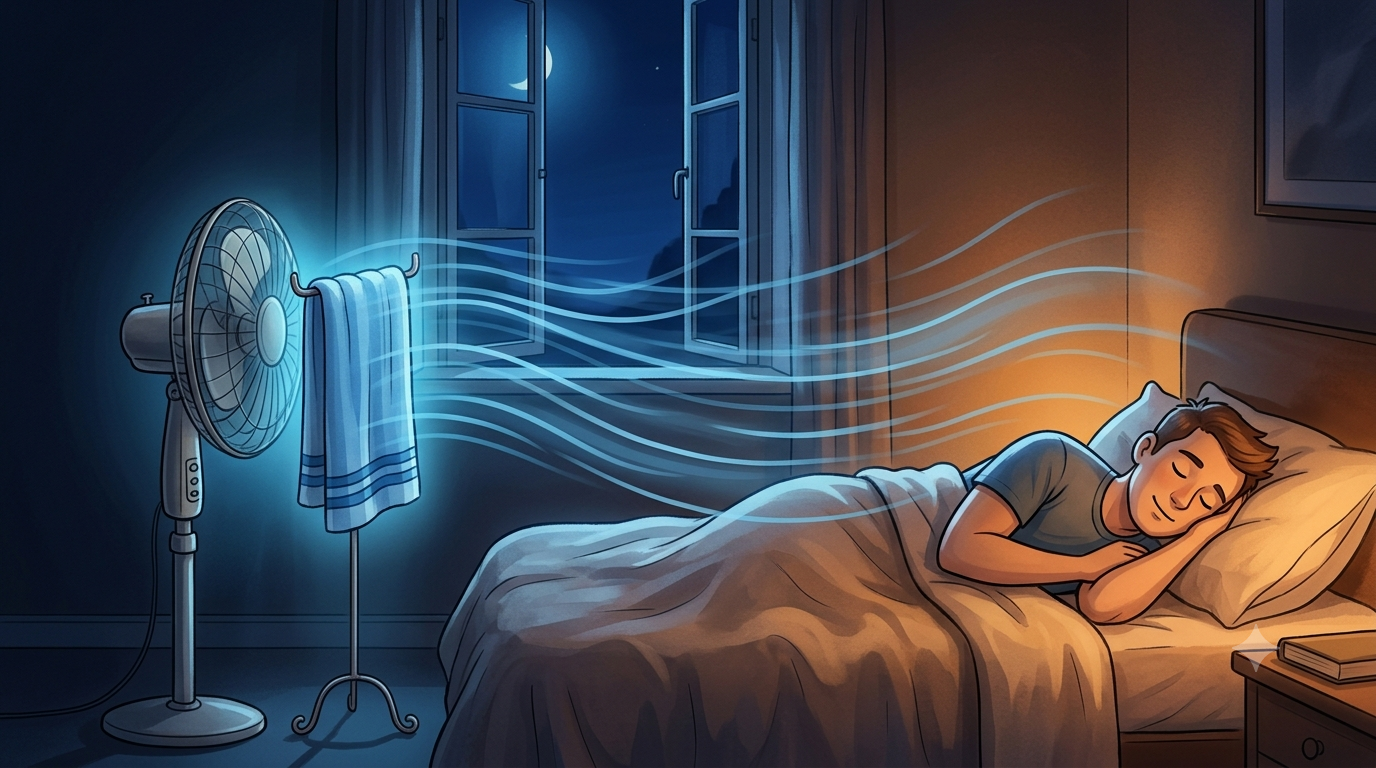
Yes — hang a damp (not dripping) towel in front of a pedestal fan, open a window on the opposite side of the room, and re-wet every 30–45 minutes. It works by evaporative cooling: water absorbs heat from the air as it evaporates, genuinely lowering air temperature by 2–4°C. It only works when humidity is below 60%. Above that, skip it — the air is already too saturated to absorb more moisture.
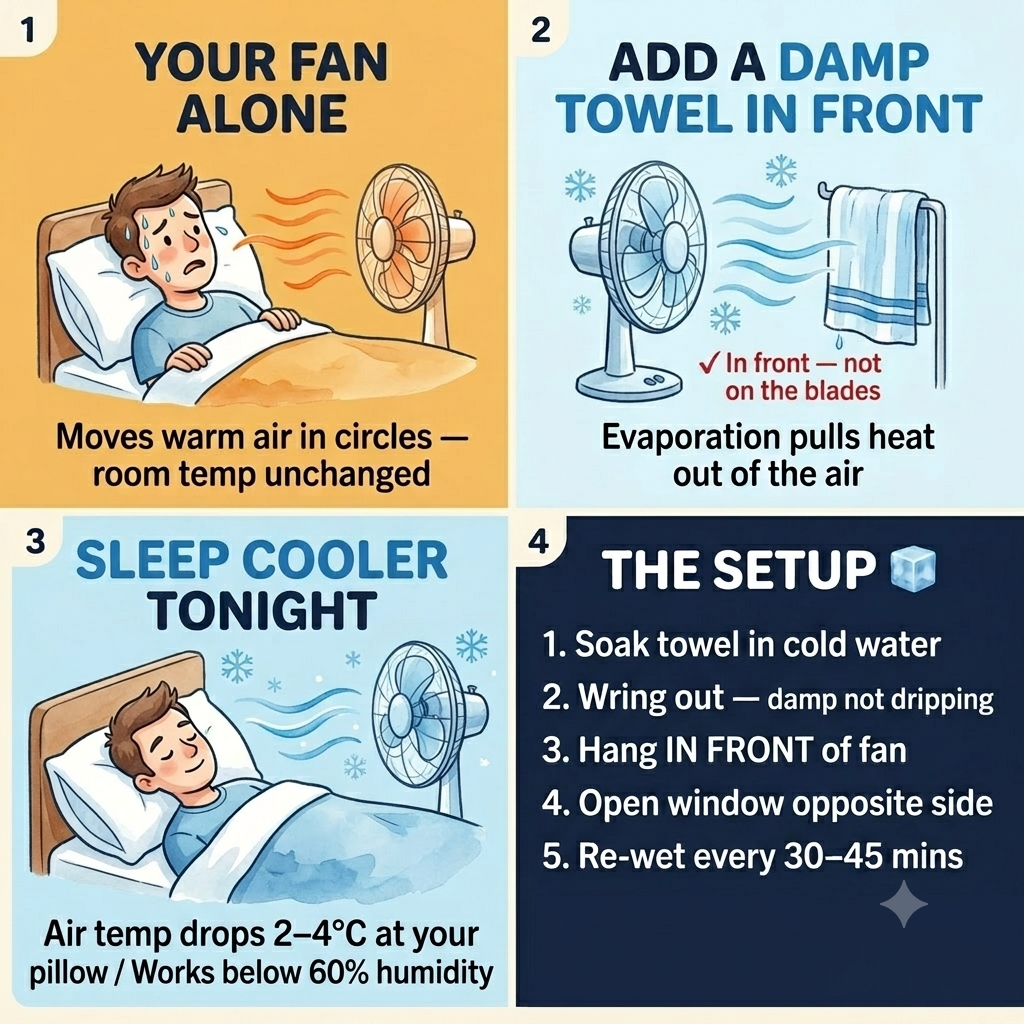
Your fan is moving air. The air is already warm. So it’s really just blowing warm air at you — which is why you’re still sweating at 2am despite having it running all night.
The wet towel is a patch — here’s the fan setup that actually cools the room →
The towel is a patch. If you want something that actually moves cooler air all night, here’s the fan guide — the fix that works even when your AC can’t keep up.
The wet towel trick changes that. It turns your fan into something that actually cools the air — not just circulates it. But it only works under specific conditions, and most people set it up wrong.
Here’s the exact science, the honest limitations, and the precise setup that drops room temperature rather than just making things feel more humid.
Why Your Fan Doesn’t Actually Cool the Air
A fan doesn’t lower air temperature. It moves air. The cooling effect you feel is wind chill — the same reason 20°C with a breeze feels cooler than 20°C in still air. Your skin perceives cooling as sweat evaporates faster, but the room’s air temperature stays the same or even rises slightly (the motor generates heat).
Once the ambient air is warm enough that your body can’t dump heat fast enough, moving warm air doesn’t help — it just dries you out while you overheat. The wet towel fixes this at the source by actually lowering the temperature of the air before it reaches you.
The Physics: Why a Wet Towel Cools Air
This is evaporative cooling. When water evaporates, it absorbs heat energy from its surroundings to power the phase change from liquid to vapour. The technical term is latent heat of vaporisation: water absorbs approximately 2,260 kilojoules of heat energy per kilogram as it converts to vapour.
That heat has to come from somewhere. It comes from the air passing through the wet towel. As the fan drives air across the damp fabric, the water evaporates rapidly, pulling thermal energy out of the passing air. The air that exits the other side of the towel is genuinely cooler — not just perceived as cooler, but measurably lower in temperature.
In dry conditions, this can drop air temperature by 2–4°C in the area downwind of the fan. That’s the difference between lying awake sweating and actually being able to sleep.
It’s the same principle used by every swamp cooler and evaporative AC unit. The wet towel is just the free DIY version.
Does It Actually Work? The Honest Answer
Yes — with one critical condition: it only works when the air is dry enough to absorb more moisture.
Think of air like a sponge. Dry air is an empty sponge — it absorbs water quickly and efficiently, and the evaporation that results pulls a lot of heat out. Humid air is a saturated sponge — squeeze more water at it and almost nothing gets absorbed. Evaporation slows to a trickle. No meaningful cooling happens. The towel just adds moisture to air that was already uncomfortable.
The threshold is 60% relative humidity. Below 60% — the trick works. Above 60% — it either does nothing or makes things worse by increasing the dew point and making the air feel more oppressive.
Where it works well: the UK during summer heatwaves (typically 40–55% RH), most of continental Europe, the US Southwest and Mountain West, Mediterranean climates.
Where it doesn’t work: Florida, the Gulf Coast, Dubai, Singapore, tropical climates — anywhere consistently above 60% humidity at night.
If you’re not sure which camp you’re in: if the room starts feeling stuffy rather than cooler after 20 minutes, humidity is your problem. Step outside — if the air feels thick and heavy rather than just hot, skip the towel entirely.
In Front or Behind the Fan?
In front — always. The towel needs to be in the path of outgoing air, not blocking the intake side.
A pedestal fan pulls air in from the back and pushes it out through the front. If you hang the towel on the back (intake side), you’re blocking the fan’s airflow before it even picks up speed — which reduces both the evaporation rate and the reach of the cooled air. Worse, wet fabric against the intake grille can get pulled into the blades.
Hang the towel over the front grille, or position it on a chair back or hook directly in front of the fan so the outgoing air passes through the damp fabric before reaching you. That’s where the heat exchange happens.
Can You Use a Wet Towel with the AC Running?
Yes, and in specific conditions it helps. If your AC is running but the bedroom still feels stuffy or the air circulation is poor, a damp towel on a pedestal fan can assist in two ways: it adds moisture back into air that’s been over-dried by the AC (AC units dehumidify aggressively, sometimes making the air uncomfortably dry), and it improves air circulation in the parts of the room the AC doesn’t reach well — particularly if your bed is in a dead zone away from the AC unit.
However, if your AC is doing its job effectively and the room is already below 22°C, the towel adds little. It’s most useful when you have AC but it’s underpowered for the room size, or when the AC runs all night but the first hour of sleep is still uncomfortable while the room cools down.
One thing to avoid: don’t point the fan directly at the AC unit’s output vent. Your AC and fan can work against each other if positioned incorrectly — the fan disrupts the cold air distribution before it can spread. Point the fan toward your bed, not at the AC.
How to Set It Up Correctly
Most people make two mistakes: they use a soaking-wet towel (which drips onto the motor), or they drape it over the fan blades (which blocks airflow and creates a safety risk). Here’s the correct setup:
What you need
- A towel or thin cotton sheet
- Cold water — tap cold is fine; do not use a frozen towel (explained below)
- A pedestal or box fan — see the three recommended pedestal fans in the hot sleeper fan guide
- An open window on the opposite side of the room
The setup
- Soak the towel in cold water, then wring it out thoroughly. It should be damp throughout — not dripping. Squeeze until no water falls when you hold it up.
- Hang the towel in front of the fan — not over the blades. Drape it over the front grille, or hang it from a chair back or hook positioned directly in front of the fan’s face so the outgoing airflow passes through the fabric.
- Point the fan toward your bed, not at the ceiling. You want the cooled air flowing across the level where you sleep.
- Open a window or door on the opposite side of the room. This is not optional. Without an exit route for the air, the local humidity around the towel rises quickly and evaporation stops. Cross-ventilation keeps fresh, drier air flowing through the towel continuously.
- Re-wet the towel every 30–45 minutes — or as soon as it no longer feels cool to the touch. Don’t wait until it’s bone dry; the cooling effect drops off as the towel dries.
Why you shouldn’t use a frozen towel
The instinct makes sense — colder should mean more cooling. The problem is that a frozen towel melts unevenly and can release water directly onto the fan motor. Water plus electric motor means, at best, a broken fan and, at worst, an electrical hazard. Cold tap water achieves nearly the same result — the limiting factor is evaporation rate, not starting temperature — without the risk.
How Long Does It Last and When to Re-Wet
A damp towel at normal summer temperatures with a fan running on medium speed will dry out in 30–60 minutes. The cooling effect tapers off well before the towel is completely dry — once it feels damp rather than cool, re-soak it.
Factors that speed up drying:
- Higher fan speeds (more airflow = faster evaporation)
- Higher ambient temperature
- Lower humidity (more capacity in the air to absorb vapour)
- A thinner towel or smaller fabric surface
Practical approach for sleep: set the fan going 20 minutes before you get into bed. Re-wet once if you’re still awake after 40 minutes. After that, let it run dry on its own — by then you should be in your first deep sleep cycle and your core temperature will have dropped naturally.
How to Get More Out of It
Add a bowl of ice
Place a bowl of ice directly in front of the fan alongside the towel. Cold air is denser than warm air, so it flows outward and downward toward your bed rather than rising. The combination — wet towel for evaporative cooling, ice for cold-air displacement — drops temperature faster than either alone. The ice lasts about an hour before needing replacement.
Use a larger surface area
A thin cotton sheet instead of a hand towel puts more damp surface in the airflow. More surface area means more evaporation happening simultaneously, which means more heat extracted per minute. In a severe heatwave, hang a damp sheet across a door frame with the fan positioned so it blows through the sheet — this approximates a basic evaporative cooler and can cool a room more broadly than a single towel.
Pre-cool the room before bed
The trick works faster from a lower starting temperature. Open windows after sunset when outdoor air drops below indoor temperature, use cross-ventilation for 20–30 minutes, then close the windows and deploy the towel as you get into bed. You’re starting from a cooler baseline, so less work for the evaporation to do.
The Sleep Physiology That Makes This Work
The wet towel trick is usually covered as a general room-cooling hack. For hot sleepers, the mechanism matters more specifically: your body can only initiate sleep when its core temperature drops by roughly 1–2°C. It achieves this by vasodilating — sending blood toward your hands, feet, and face so heat can radiate outward. If the ambient air is warm, this process slows down. Cooler air accelerates it.
Which means the wet towel doesn’t need to run all night. It needs to run for the 20–30 minutes before and during sleep onset. Once you’re in deep sleep, your body’s thermoregulation handles the rest and a slightly warmer room matters far less.
Not sure if heat is what’s waking you up, or something else? Take the hot sleeper diagnostic to find the actual bottleneck.
When to Skip the Towel and Do Something Else
If your humidity is above 60%, the wet towel adds moisture to an already uncomfortable room without meaningfully cooling it. Alternatives that work regardless of humidity:
- Fan pointed outward through the window — exhausts hot indoor air. Open a window in another room to draw cooler air in through that gap. See the fan positioning guide for the exact setup.
- A warm bath or shower 60–90 minutes before bed — warm water dilates the blood vessels in your skin, drawing blood to the surface where heat radiates out. Core temperature drops faster, and sleep onset is earlier. This is why the timing matters: too close to bed (under 30 minutes) and you haven’t had time to radiate the heat before lying down.
- Breathable bedding — sheets that conduct heat away from your skin work regardless of ambient humidity. Bamboo viscose and percale cotton are the two materials that make a measurable difference. See the cooling sheets guide for verified options.
- Freeze your pillowcase for 30 minutes before bed — place it in a sealed bag, freeze it, take it out 5 minutes before you need it. The cold conducts directly to your head and neck, which are the highest blood-flow areas for heat dumping.
Frequently Asked Questions
Should the wet towel go in front of or behind the fan?
In front — in the path of the outgoing air. Hanging the towel on the back (intake side) blocks airflow and reduces the evaporation rate. The towel needs to be in the stream of air that the fan is pushing toward you, not blocking the air the fan is pulling in.
Does putting a wet towel over the fan blades work?
No — and it’s a safety hazard. Fabric draped over spinning blades restricts airflow, strains the motor (which can overheat), and can be pulled into the blades. Always hang the towel over the front grille or position it in the airstream in front of the fan, not over the blades themselves.
Can I put a wet towel on a ceiling fan?
No. A ceiling fan spins horizontally — a wet towel on the blades would be a serious projectile risk. The wet towel trick only works with a pedestal fan or box fan where you can hang the towel stably in the airflow path.
Will a wet towel on a fan cause mould?
Only if you leave a damp towel in a closed room with no airflow. When the fan is running with a window open, moisture evaporates into the outgoing air rather than settling on surfaces. Wash the towel after use and don’t leave it in a damp pile.
Is the wet towel fan trick safe?
Yes, with two conditions: wring the towel thoroughly so it’s damp not dripping, and hang it in front of the fan rather than touching the blades or motor. A dripping-wet towel near an electric motor is the one genuine risk. Damp fabric positioned in the outgoing airflow — not touching any moving parts — is safe.
The Bottom Line
The wet towel trick works. The physics are real — evaporation extracts heat from passing air, and a fan accelerates it enough to drop the temperature at your sleeping position by a few degrees. If your humidity is below 60%, you have a window to open, and you hang the towel in front of the fan (not over the blades), you have a free, functioning evaporative cooler.
If your humidity is above 60%, it won’t work — switch to conductive cooling through your bedding instead.
The difference between a fan that just recirculates warm air and one that actually lowers the temperature of the air reaching you is a damp towel and an open window. That’s it.
Frequently Asked Questions
Does putting a wet towel over a fan make it cooler?
Yes — in low-humidity conditions. Air passing through wet fabric drops in temperature by 2–5°F through evaporative cooling. In humid climates above 60% humidity, the effect is minimal because the air cannot absorb more moisture.
Where do you put the wet towel — in front of or behind the fan?
Drape it over the front of the fan (the side facing you). The fan pulls air through the wet fabric and cools it before it reaches you. Putting it behind the fan does not work — the air has already passed through.
How long does the wet towel fan trick last?
About 1–2 hours before the towel dries out. In hot, dry conditions it may dry in 45–60 minutes. Wring the towel out well so it is damp but not dripping, and replace it when it feels dry to the touch.
Is it safe to put a wet towel on a fan?
Yes, as long as you wring the towel out thoroughly so it is damp — not dripping. Excess water dripping into the motor is the main risk. Keep the towel loosely draped over the front grille, not wrapped tightly around the fan body.
Does a wet towel cool the whole room or just the air near the fan?
Primarily the air directly in front of the fan within 4–6 feet. For a whole-room effect, place the fan near a window to draw in cooler outside air, with the wet towel adding evaporative cooling on top.
Does hanging a wet towel in a room cool it down without a fan?
Very slightly. Without airflow, evaporation is slow and the cooling effect is minimal — maybe 1°F in the immediate area. A fan dramatically speeds up evaporation and makes the trick actually effective.
Can you use a wet cloth or wet rag instead of a towel?
Yes. Any thin absorbent fabric works — a wet cloth, microfiber towel, or thin cotton sheet. Avoid thick terry cloth which holds too much water and can drip into the motor. Thin cotton absorbs and releases moisture most effectively.