
Does Memory Foam Make You Sweat? The Physics, the Marketing, and What Actually Works
Quick answer
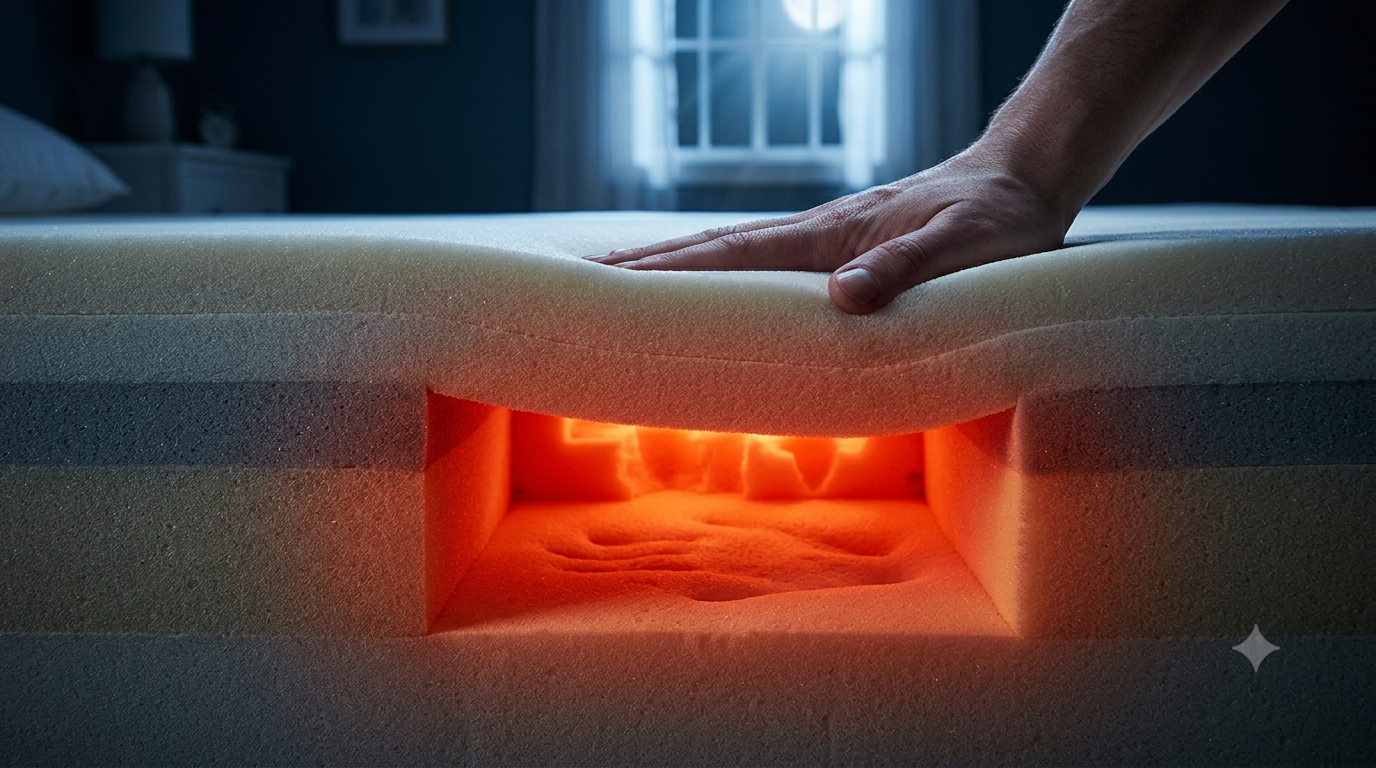
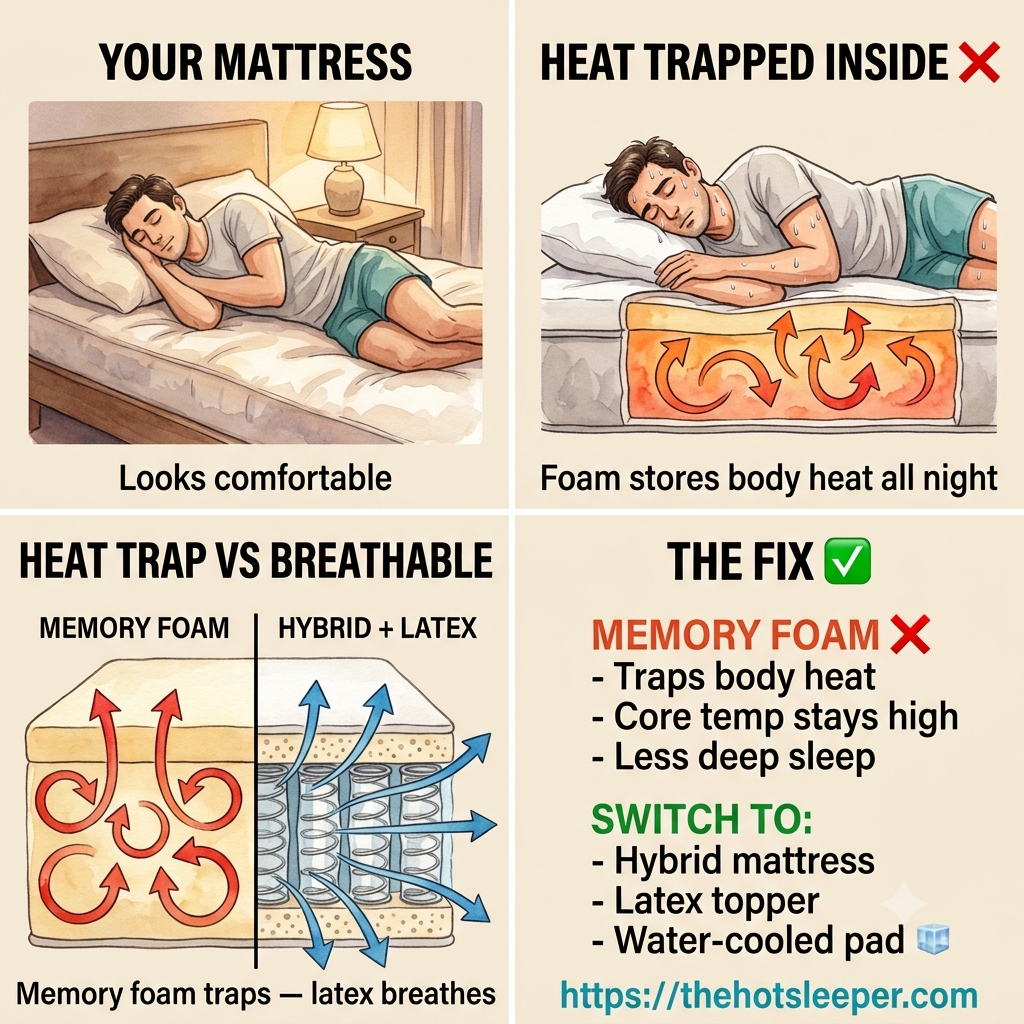
Yes — memory foam traps heat by design. Its dense, viscoelastic structure acts as an insulator, absorbing and holding your body heat rather than letting it dissipate. The higher the foam density (and the more you paid), the worse the problem. Gel-infused foam is largely a marketing claim. The only reliable fix is reducing the amount of foam you’re sleeping on — either by switching to a hybrid mattress or adding a breathable topper that creates distance between you and the foam.
You paid good money for it. The salesperson told you it would be the best sleep of your life. And now, six months in, you’re waking up at 2am soaked, kicking off the covers, wondering what went wrong.
Nothing went wrong with you. Memory foam has a heat problem the mattress industry has spent decades trying to engineer around — and mostly failing. Here’s what’s actually happening inside the foam, what Reddit’s hot sleepers figured out after spending thousands on mattresses, and what genuinely works.
The Physics: Why Memory Foam Traps Heat
Memory foam is viscoelastic polyurethane foam. The “memory” part — the slow, body-conforming sink — happens because heat from your body reduces the foam’s viscosity, making it softer. The material is literally activated by your body heat.
That same mechanism is exactly what makes it hot to sleep on. A widely-cited r/Mattress thread from a manufacturer with over a decade of direct experience building and selling mattresses explained it this way: foam acts as a thermodynamic insulator — slowing the flow of heat from your body to the surrounding environment. The more foam volume, the more insulation. The heat isn’t trapped because of a manufacturing defect. It’s trapped because that’s how the material behaves by definition.
Your body produces roughly 80 watts of heat during sleep — about the same as an old incandescent bulb. That heat needs somewhere to go. With an innerspring mattress, it dissipates through the air gaps between coils. With an all-foam mattress, there are no air gaps. The heat goes into the foam, and stays there.
Over the course of a night, the foam around your body reaches something close to your own temperature. You’re sleeping inside a heat envelope of your own making — and it gets worse the longer you stay in one position.
The Density Paradox: Better Quality Foam Sleeps Hotter
Here’s what the mattress industry doesn’t advertise: foam density — the main quality marker — correlates directly with heat retention. The r/Mattress community FAQ states it plainly: lower-density foam contains more air pockets and allows more airflow, so it runs slightly cooler. Higher-density foam packs those pockets tighter — reducing airflow, increasing heat retention.
Standard foam density is measured in pounds per cubic foot (lb/pcf). Under 3.0 lb/pcf is low quality. 4.0 lb/pcf is mid-range. 5.0 lb/pcf and above is premium — the grade used in Tempur-Pedic mattresses.
This creates a brutal paradox: if you spent significantly more for “better quality” foam, you almost certainly bought a denser product — which sleeps hotter than the cheap version. The premium Tempur-Pedic owner paid more to sleep on a more effective heat trap. And the complaints bear this out: Tempur-Pedic is one of the most frequently named mattresses in r/sleep heat threads, precisely because it uses some of the densest foam on the market.
What Reddit’s Hot Sleepers Actually Discovered
Across r/Mattress and r/sleep, the pattern of complaints is strikingly consistent. People don’t just say they’re hot — they describe the same progressive experience: fine when they first lie down, increasingly uncomfortable after an hour, fully awake and sweating by 2–3am. The foam needs time to reach body temperature. Once it does, there’s no escape from it.
One highly-upvoted comment in a r/sleep thread on chronic night sweats named Tempur-Pedic mattresses specifically as “insanely hot” for someone who already runs warm — and added that jersey-knit sheets compound the problem significantly. Both observations came up in multiple independent threads, which is why they’re worth taking seriously.
A separate r/sleep discussion about a partner who soaks the bed every night captured the frustration that characterizes most of these threads: AC, fans, lighter blankets, different sheets — all tried, all helped a little, none of them stopped the overheating once the person was actually asleep and in contact with the foam. That pattern — surface fixes that help at the margins but don’t solve it — is the tell that the mattress itself is the bottleneck.
The showroom problem is a third consistent theme. The same r/Mattress manufacturer thread identified why so many people only discover the issue after purchase: showrooms are air-conditioned, and you’re on the mattress for 10–20 minutes without a blanket. The heat buildup that makes memory foam unbearable for a hot sleeper takes at least an hour to develop. You can’t feel it in a store. You’ll feel it on night one at home.
The “Cooling” Memory Foam Myth
Walk into any mattress store and you’ll see gel-infused foam, copper-infused foam, graphite, phase-change materials, and “open-cell” technology — all presented as the fix for memory foam’s heat problem.
The same r/Mattress manufacturer was direct about it: dyeing foam blue or adding gel beads does not significantly change the material’s fundamental thermal properties. What matters is foam volume. That’s the conclusion he reached after years of experimenting with additives and alternatives for customers who slept hot — reduce the foam, and the heat problem reduces with it. Add an additive to the same volume of foam, and you get marginal improvement at best.
The mechanism explains why. Gel conducts heat — it moves it from one spot to another within the foam layer. But there’s nowhere for it to go. The foam is still a sealed insulating environment. Conduction and dissipation are different processes, and gel only does the first.
Open-cell foam is a genuine step up over traditional closed-cell foam — it does allow more airflow through the material. But “more airflow than traditional memory foam” is an extremely low bar. Open-cell foam still retains heat at a rate that a spring-based system with actual air gaps cannot match.
How to Tell If Your Mattress Is the Problem
Not every hot sleeper has a mattress problem. Rule these out first:
- Synthetic sheets. Polyester, microfiber, and jersey-knit trap heat independently of your mattress. In the same r/sleep night sweat thread, a commenter described switching from synthetic to 100% cotton percale and stopping waking up sweaty entirely — without changing anything else. If you’re on synthetic sheets, test cotton percale or linen before drawing conclusions about the mattress.
- Room above 66°F (19°C). Even the most breathable mattress can’t overcome a genuinely hot room. Get the room to 65–68°F before blaming the foam.
- A medical cause. Perimenopause, thyroid conditions, certain medications, and infections all cause night sweats independently of sleep surface. If you’re waking up soaked and it started recently or suddenly, see a doctor before spending money on mattress solutions. This article is general information, not medical advice.
The clearest sign the mattress is the problem: you sleep fine in hotels (which use innerspring or hybrid almost universally), or cooler on a sofa or different bed. If the heat is specific to your own mattress, the mattress is the variable.
The fix isn’t a new mattress.
A cooling topper changes the sleep surface you actually contact — without replacing the mattress underneath. Here’s what the community actually recommends:
See the Reddit-Verified Topper Guide →Fixes That Actually Work — Ranked by Impact
1. Switch to a Hybrid (Highest Impact)
A hybrid mattress uses a pocket-spring base with a thin comfort layer on top — typically 2–4 inches of foam or latex rather than 8–12 inches of all-foam. The spring system creates passive airflow through convection: air moves between the coils as you shift position, carrying heat away from the surface.
The r/Mattress manufacturer’s conclusion after years of trying to solve this for customers was simply: reduce the foam. A spring base with a thin comfort layer dissipates heat. An all-foam mattress — regardless of what it’s infused with — insulates. See the hot sleeper mattress guide for hybrid picks that have consistently performed well on heat.
2. Cooling Mattress Topper (High Impact, More Affordable)
If replacing the mattress isn’t an option, a cooling mattress topper can meaningfully reduce the problem by creating a breathable buffer between you and the foam. Best options for hot sleepers: natural latex (open-cell structure, doesn’t heat-activate the way viscoelastic foam does) or wool (regulates both temperature and moisture).
Avoid gel memory foam toppers. They have the same fundamental heat-trap problem as the mattress beneath them — just in a thinner layer. See the FAQ below for a full breakdown.
If you want a specific recommendation: a 2–3 inch natural latex topper is the most frequently cited fix in r/Mattress threads for people who can’t replace their mattress. It adds enough of a breathable layer to make a real difference without the cost of a new mattress. See the topper guide for the specific picks.
3. Water-Cooled Mattress Pad (High Impact, Expensive)
Products like the Ooler Sleep System circulate temperature-controlled water through a pad that sits on top of your mattress. They sit at the higher end of the price range, but they’re the only solution that actively removes heat rather than passively managing it. For severe cases — waking soaked every night, multiple times — this is the most reliable fix short of replacing the mattress entirely.
4. Fix Your Sheets First (Moderate Impact, Low Cost)
Memory foam’s heat problem is real, but synthetic sheets compound it significantly. The r/sleep commenter who switched from synthetic to 100% cotton percale and stopped waking up sweaty entirely pointed to the sheets — not the mattress — as the first thing to change. If you have a memory foam mattress and you’re on polyester or microfiber, fix the sheets before anything else.
Cotton percale and linen are the standards. See the cooling sheets guide for what actually performs well — and this breakdown of why sheets make you sweat explains the fabric mechanics in detail.
5. Cool the Room Before Bed (Moderate Impact, Free)
Memory foam absorbs heat from the room throughout the evening. The cooler you get the room before you lie down, the lower the foam’s starting temperature — which slows how quickly the heat envelope builds. Target 65–68°F (18–20°C). Cross-ventilate in the evening: position a fan in a window to exhaust hot indoor air out, with another window open on the opposite side of the room to draw cooler air in. A fan at the bedside creates wind chill on your skin but doesn’t lower air temperature — a distinction the wet towel fan trick guide covers in detail. Start ventilating at least an hour before bed so the room — and the foam — has time to reach a lower baseline before you lie down.
The Moisture Problem Nobody Mentions
Heat is the obvious complaint, but the r/Mattress manufacturer raised a second consequence that almost nobody discusses: moisture accumulation inside the foam over time.
Your body produces significant moisture during sleep through both respiration and perspiration. With an innerspring mattress, that moisture evaporates through the open coil structure. With an all-foam mattress, it absorbs into the foam and has nowhere to go. The same manufacturer described receiving customer photos showing mold between the mattress and its base — a direct result of years of moisture saturation with no ventilation path out.
This has two implications. First, a mattress protector only covers the top surface — moisture still penetrates down. Second, foam’s heat performance degrades over time not just because the cell structure breaks down, but because increasingly moisture-saturated foam retains heat more effectively than dry foam. The mattress that already runs warm when new runs warmer at year three.
When to Fix vs When to Replace
Fix first if: the mattress is under two years old, you haven’t tried proper breathable sheets, or the heat is mild — warm but not waking up multiple times. Start with cotton percale sheets, add a latex topper, see if that’s enough.
Replace if: you’re waking up soaked consistently, the mattress is three or more years old (degradation compounds the heat problem), or you’ve made multiple changes without meaningful improvement. When replacing, choose a hybrid with a thin comfort layer — not another all-foam mattress with a different brand name on the label.
Still not sure what’s causing it?
The Hot Sleeper Quiz takes 60 seconds and tells you exactly which layer of your sleep environment is the problem — and what to change first.
Take the Quiz Free →Frequently Asked Questions
Does memory foam make you sweat?
Yes. Memory foam’s dense, viscoelastic structure acts as an insulator — it absorbs and holds your body heat rather than letting it dissipate. Over the course of a night you build up a heat envelope around your body. Higher foam density means less airflow, which means more heat trapped. The sweating is a response to that accumulated heat, not a malfunction on your body’s part.
Do memory foam mattress toppers make you hot?
Gel memory foam toppers do, yes — they have the same fundamental heat-trapping properties as a full memory foam mattress. The only difference is thickness. If you’re buying a topper specifically to cool down a hot memory foam mattress, gel foam will not solve the problem and may make it slightly worse by adding another insulating layer.
Latex and wool toppers are the right call. Natural latex uses an open-cell structure that allows airflow, and it doesn’t use the viscoelastic heat-activation mechanism that makes memory foam trap warmth. Wool regulates moisture as well as temperature. Either creates a genuinely breathable buffer between you and the memory foam beneath.
Does gel memory foam sleep cooler?
Only marginally. Gel creates an initial cool-to-touch sensation — it conducts heat, moving it from the surface to the interior of the foam. But conducting heat and dissipating it are different processes. Once the gel reaches equilibrium with your body temperature (typically within 60–90 minutes of lying down), the cooling effect is gone. At that point you’re sleeping on insulated foam with gel in it, which is essentially what you had before.
Why do I sleep hot on memory foam but cool in hotels?
Hotel mattresses are almost universally innerspring or hybrid — pocket coils with a thin comfort layer on top. This is commercial hospitality’s standard for durability and maintenance reasons, but the side effect is that coil-based mattresses allow air to circulate through the spring system, carrying heat away from the surface. If you consistently sleep cooler in hotels, your mattress type is the variable, not your body temperature regulation.
Is latex foam cooler than memory foam?
Yes, consistently. Natural latex has an open-cell structure with larger air pockets than viscoelastic foam, allowing better airflow. It also doesn’t heat-activate the way memory foam does — it doesn’t use your body heat to conform, so it doesn’t trap it. For hot sleepers who want an all-foam surface, latex is substantially better than memory foam for temperature regulation. It’s also why latex toppers are one of the most commonly recommended fixes in r/Mattress for people stuck with an existing foam mattress.
Does memory foam get hotter over time?
Yes — for two compounding reasons. First, the foam’s cell structure breaks down with use, becoming denser and less air-permeable as the walls between cells collapse. Second, foam gradually absorbs moisture from your body each night, and moisture-saturated foam retains heat more effectively than dry foam. A mattress that runs warm when new will almost certainly run hotter at year three or four.
The Bottom Line
Memory foam’s heat problem isn’t a defect — it’s physics. The same dense, slow-conforming structure that makes it pressure-relieving is why it insulates rather than dissipates. Cooling gels, copper particles, and open-cell technology all attempt to work around a fundamental material property. They help at the margins. They don’t solve it.
The mattress manufacturer who spent over a decade trying to find a fix for hot-sleeping customers arrived at the same conclusion every time: reduce the foam. A spring base with a thin comfort layer dissipates heat through convection. An all-foam mattress — regardless of what it’s infused with or what color the foam is — is an insulator.
If you’re waking up hot and sweating in bed, start with your sheets and room temperature. If the problem persists, the mattress is your bottleneck — and the fix is less foam, not different foam. Your pillow is worth checking too — see what actually works for cooling pillows.