
Hot Sleeper Solutions: 15 Proven Ways to Cool Down at Night
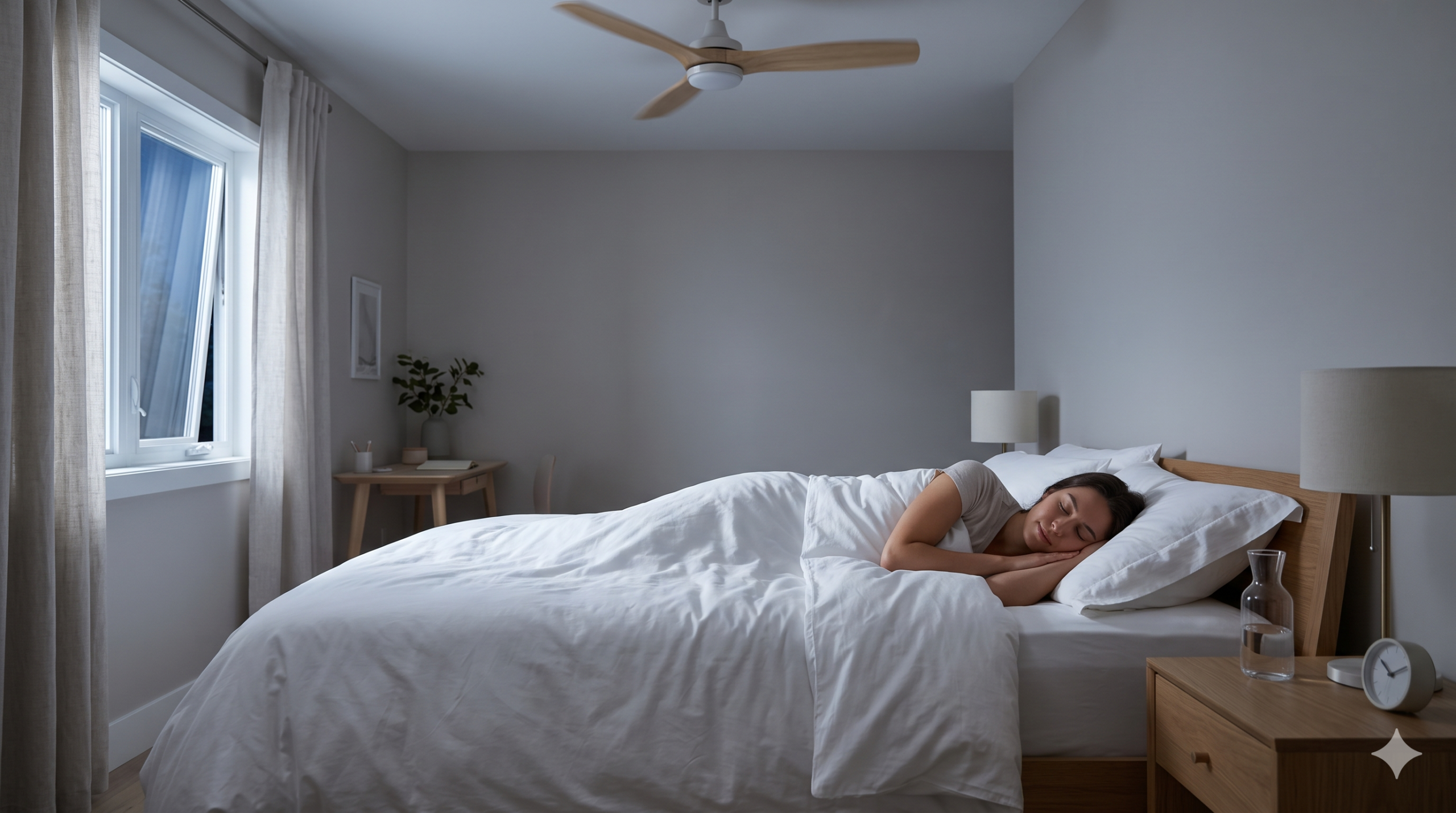
Hot sleeper solutions are changes to your bedding, bedroom environment, mattress, and pre-sleep habits that reduce the excess heat your body generates or traps during the night. Most hot sleepers need more than one fix — the solutions below are ranked by how much impact they typically deliver, starting with the changes that work fastest.
If you are not sure whether you are a hot sleeper or dealing with something else, read What Is a Hot Sleeper? first. This article assumes you have already confirmed the pattern and want to fix it.
Bedding Solutions (1–6)
Your bedding is the single biggest lever. It surrounds your body for eight hours and either traps heat or releases it. Start here before spending money on anything else.
1. Switch to Percale or Bamboo Sheets
Swap polyester or sateen-weave cotton for percale or bamboo sheets — the two fabrics that consistently sleep coolest for hot sleepers. Most budget sheets use polyester or sateen-weave cotton, both of which trap heat and create a greenhouse effect around your body.
The two fabrics that consistently outperform everything else:
- Percale cotton — a tight, matte weave that stays cool and crisp. It breathes better than sateen at the same thread count.
- Bamboo (viscose or lyocell) — naturally moisture-wicking, temperature-regulating, and significantly softer than cotton at equivalent price points.
Linen is also worth considering if you run extremely hot — it has the best airflow of any natural fiber, though the texture takes some getting used to.
→ See the full breakdown: Best Cooling Sheets for Hot Sleepers
2. Replace Your Comforter with a Lightweight Alternative
Replace heavy synthetic comforters with a lightweight alternative — look for a fill power under 500 or a fabric weight under 200 GSM (the US equivalent of a European 4.5 tog). Heavy comforters filled with synthetic fibers are the most common reason hot sleepers wake at 3am drenched in sweat.
- Fill power under 500 — lower fill power means less insulation, which means less trapped heat
- Eucalyptus or bamboo fill — both regulate temperature better than polyester or goose down
- Fabric weight under 200 GSM — anything heavier traps heat year-round, not just in summer
→ Best Cooling Comforters for Hot Sleepers
3. Try the Two-Duvet Method
If you share a bed with a partner who sleeps cold, use two separate duvets instead of one shared comforter — each matched to the individual sleeper’s temperature needs. With one shared comforter, one of you will always be too hot or too cold. There is no middle ground.
The Scandinavian method is simple: two separate duvets, each matched to the individual sleeper’s temperature needs. The hot sleeper uses a lightweight cooling duvet. The cold sleeper uses whatever weight they need. Neither person wakes the other by stealing covers at 3am.
This is not a compromise. It is the correct solution for temperature-mismatched couples.
→ Full guide: Hot Sleeper vs Cold Sleeper: How to Share a Bed Without Ruining Your Sleep
4. Switch to a Cooling Pillow
Replace dense memory foam with shredded latex or buckwheat to stop your pillow from trapping heat against your head and neck. Your pillow sits directly against your face and neck for eight hours — standard memory foam pillows trap heat by design, and the gel layers added to “cooling” memory foam pillows typically stop working within 20 minutes.
- Shredded latex — natural latex has open-cell structure that allows continuous airflow
- Buckwheat — breathes exceptionally well, though it is heavier and firmer than most people expect
- Copper-infused foam — conducts heat away from the surface rather than reflecting it back
A pillowcase made from bamboo or percale amplifies the effect.
→ Best Cooling Pillows for Hot Sleepers
5. Ditch Synthetic Sleepwear
Switch polyester sleepwear for 100% cotton, bamboo, or nothing at all — synthetic fabrics trap sweat against your skin rather than absorbing it.
- 100% cotton — absorbs sweat, breathes, washes easily
- Bamboo sleepwear — softer than cotton, better moisture-wicking
- Nothing — the simplest solution and the one with the most airflow
6. Add a Cooling Mattress Topper
Add a latex or wool cooling topper to a heat-retentive mattress — the fastest upgrade for a hot bed short of replacing the mattress entirely.
- Latex toppers — open-cell natural latex allows airflow and sleeps significantly cooler than memory foam
- Wool toppers — regulates temperature in both directions, effective even in warm climates
- Phase change material (PCM) toppers — absorb heat at a specific temperature threshold and release it slowly. More expensive, but performance is measurable.
Avoid gel memory foam toppers. The gel layer equilibrates to body temperature within 30 minutes.
→ Best Cooling Mattress Toppers for Hot Sleepers
Not sure which solutions apply to your situation?
The Sleep Heat Quiz asks 5 diagnostic questions and tells you exactly which of the 15 fixes will make the biggest difference for your specific pattern — in under three minutes.
Take the Free Quiz →Environment Solutions (7–11)
Bedding cannot compensate for a hot room. Your bedroom environment sets the baseline — everything else works better when the room itself is cool.
7. Set Your Bedroom to 65–68°F (18–20°C)
Set your bedroom thermostat to 65–68°F (18–20°C) — the temperature range sleep researchers consistently identify as optimal for initiating and maintaining deep sleep. Your core body temperature needs to drop by 1–2°F to enter deep sleep, and a room warmer than this range actively fights that process.
Most people keep their bedrooms at 70–72°F. Program your thermostat to drop to 65°F about an hour before bedtime so the room is already at target temperature when you get in.
8. Position a Fan for Cross-Ventilation
Position your fan to create cross-ventilation rather than just circulating warm air — place it facing inward at a window on the cooler side of your home, then open a window on the opposite wall to pull a genuine breeze through the room.
If you are using a bedroom fan without window access, position it at the foot of the bed angled up toward the mattress — not directly at your face, which can dry out your sinuses. Fans rated below 45 decibels also mask ambient noise, which independently improves sleep quality for light sleepers.
9. Block Heat from Windows Before It Enters
Close blackout curtains during the hottest part of the day (10am–4pm) to block the 30% of bedroom heat that enters through windows, according to the US Department of Energy. Once radiant heat is inside, prevention is the only efficient approach.
- Blackout curtains — close during peak sun hours; open at night when outdoor air cools
- Reflective window film — blocks heat year-round without darkening the room
- External shading — awnings or external blinds stop heat before it hits the glass
10. Remove Heat Sources from Your Bedroom
Switch off electronics at the wall rather than leaving them on standby — a TV, gaming console, and charging cables can raise a small bedroom’s temperature by 1–3°F.
- Switch off all electronics at the wall before bed
- Move phone charging to a hallway or adjacent room
- Replace incandescent or halogen bulbs with LED — 75% less heat for the same light output
11. Pull Back Your Top Cover 30 Minutes Before Bed
Pull your top cover down to the foot of the bed 30 minutes before you get in — a made bed traps the heat your room has accumulated all day inside the mattress, and airing it out first removes that stored warmth before a human body adds more.
A made bed acts as a sealed terrarium for heat: the duvet traps ambient daytime temperature inside the mattress surface all afternoon. Turning back the cover at 9:30pm lets the mattress dump that stored heat into the room before you arrive.
Mattress Solutions (12–13)
If your mattress is the primary heat source, no amount of bedding changes will fully fix the problem.
12. Replace All-Foam with a Hybrid or Latex Mattress
Replace your all-foam mattress with a hybrid or natural latex model — both use coil or open-cell construction that allows airflow that dense memory foam cannot replicate.
- Hybrid mattresses — pocketed coil support with foam comfort layers. The coil layer creates significant airflow through the mattress core that pure foam cannot match.
- Natural latex mattresses — open-cell structure allows continuous airflow and sleeps significantly cooler than memory foam at comparable price points.
→ Full comparison: Best Mattresses for Hot Sleepers
13. Check Your Mattress Age
Check whether your mattress is more than 7–8 years old — compressed foam loses its open-cell structure and airflow capacity over time, turning a once-neutral mattress into a heat trap. If you have started sleeping hotter in recent years without other obvious changes, age is a primary suspect.
Pre-Sleep Behavior (14–15)
What you do in the two to three hours before bed directly affects your core body temperature at sleep onset. These two changes cost nothing and work immediately.
14. Take a Warm Shower 60–90 Minutes Before Bed
Take a warm (not cold) shower 60–90 minutes before bed — the rapid temperature drop after you step out triggers your hypothalamus to accelerate the core cooling your body needs to initiate sleep. A cold shower feels refreshing but causes your body to generate compensatory heat afterward.
A 2019 meta-analysis in Sleep Medicine Reviews found that warm water immersion 1–2 hours before bedtime reduced sleep onset time by an average of 10 minutes. For a hot sleeper, that is a meaningful gain.
15. Stop Drinking Alcohol at Least Three Hours Before Sleep
Stop drinking alcohol at least three hours before sleep — it widens blood vessels, raises skin temperature, and disrupts the second half of the night when most thermal regulation occurs. The vasodilatory effect of a standard drink peaks at about 45 minutes and takes two to three hours to clear.
This is not about cutting alcohol entirely — it is about timing.
Where to Start: The Priority Order
If you implement all 15 changes at once, you will not know what worked. Address them in order of impact:
Week 1: Sheets + comforter + bedroom temperature. Under $150, noticeable results within the first few nights.
Week 2: Fan positioning + window management + pre-bed shower timing. Free changes that stack on top of the bedding fixes.
Week 3: Pillow switch if still waking hot in the first half of the night.
If still struggling: Assess the mattress. All-foam over five years old is the likely root cause bedding changes cannot fully compensate for.
For a personalized sequence based on your specific pattern, take the Sleep Heat Quiz — it generates a custom cooling plan in under three minutes.
Frequently Asked Questions
What is the most effective hot sleeper solution?
Switching to percale or bamboo sheets combined with setting your bedroom to 65–68°F produces the fastest results. If your mattress is all-foam, adding a latex cooling topper is the next highest-impact change.
Can hot sleeping be fixed without buying new products?
Yes. Setting your thermostat correctly, repositioning your fan, blocking daytime heat from windows, switching off standby electronics, pulling back your top cover 30 minutes before bed, and taking a warm shower 90 minutes before sleep are all free. For most mild hot sleepers, these behavioral adjustments alone produce significant improvement.
How long does it take for cooling solutions to work?
Bedding changes produce noticeable results on the first or second night. Behavioral changes like shower timing and alcohol cutoff work immediately. Mattress changes take three to seven nights as your body adjusts.
Why do I wake up hot at 3am specifically?
3am is when your body’s core temperature typically reaches its lowest point. The transition between sleep stages is when your body makes its largest temperature adjustments — if bedding is trapping heat, this becomes uncomfortable enough to wake you. Covered in detail in Why Am I Such a Hot Sleeper?
Do cooling mattress pads actually work?
It depends on the type. Phase change material (PCM) pads, convective air systems like BedJet, and hydro-powered systems like Eight Sleep all produce measurable results. Gel-infused foam pads typically equilibrate to body temperature within 30 minutes. See the cooling mattress topper guide for the full breakdown.
Curious what chronic hot sleepers are saying in 2026? See: Best Cooling Mattress Topper: What Reddit Actually Says (2026).
Is being a hot sleeper a medical problem?
Being a hot sleeper is not a medical condition — it is a physiological pattern with fixable causes. However, if you wake drenched in sweat regardless of environment and the pattern developed suddenly, see a doctor. The distinction is covered in Night Sweats vs Hot Sleeper: What’s the Difference?